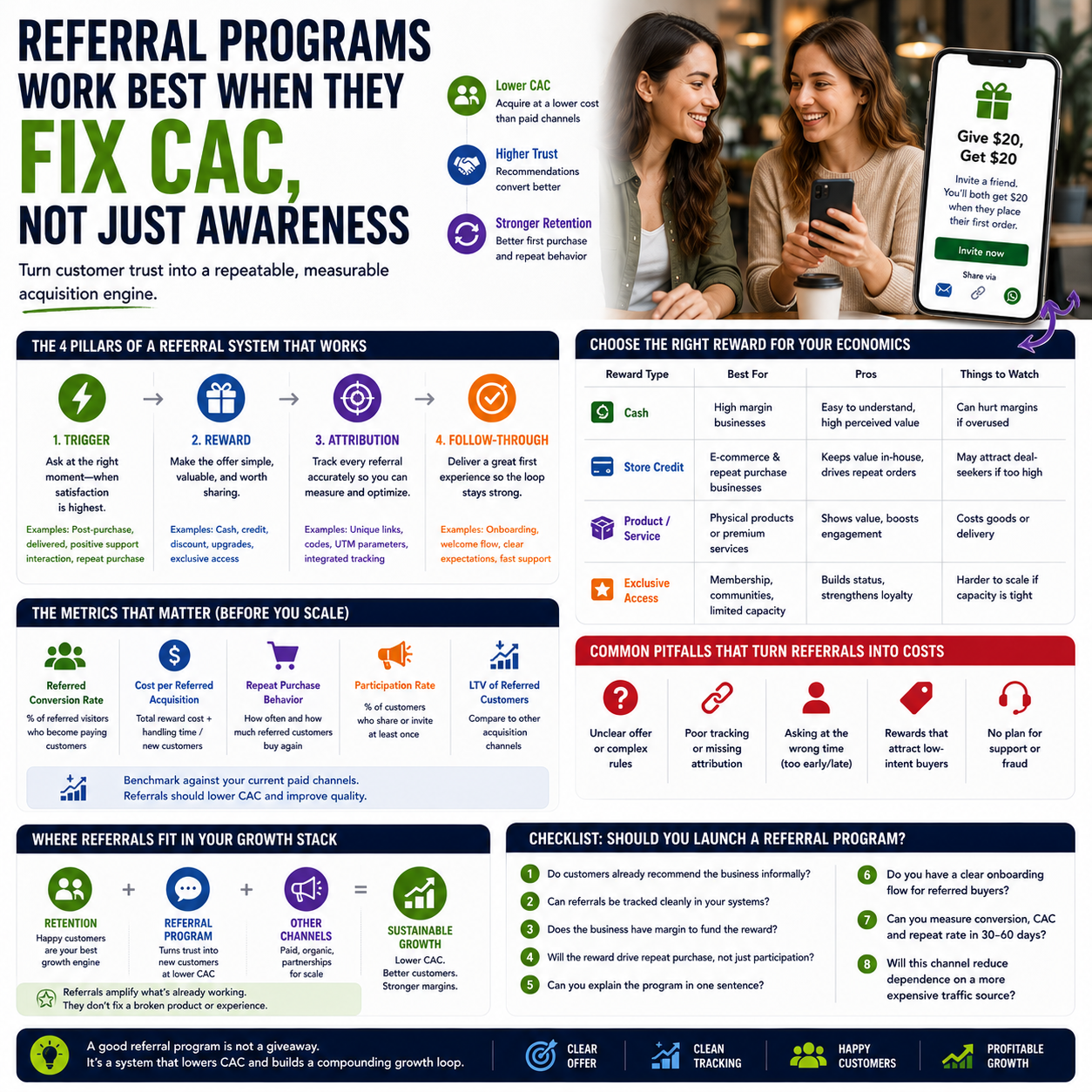
Referral programs sound simple, but the real question for operators is not whether customers like them. The question is whether they lower acquisition cost, bring in the right buyers, and create a repeatable growth loop that can be tracked in the business.
That is why referral programs should be treated less like a marketing tactic and more like a system design problem. If the offer, tracking, onboarding, and reward structure are weak, you end up paying for noise instead of profitable customers.
Why referral programs are worth considering now
A referral program can do more than generate leads. It can shift customer acquisition away from channels that get more expensive over time and toward customers who arrive with built-in trust. For small businesses, that matters because referral traffic often converts differently from cold traffic: it can shorten the sales cycle, reduce objection handling, and improve first-order confidence.
But the operational value is not automatic. A referral program only helps if it is tied to a specific business problem. For example, if paid ads are rising in cost, a referral program may be a better route to keep CAC under control. If repeat customers are strong but acquisition is weak, referrals can turn customer goodwill into a measurable source of new buyers. If your business sells a product with strong word-of-mouth potential, referrals may be a more scalable channel than broad brand campaigns.
What makes a referral program actually work
The strongest referral programs are built around one simple rule: the customer should understand the offer in seconds. If the mechanism needs explanation, participation drops. This is where many programs fail. They ask people to advocate for the business, but they do not make it obvious what to share, when to share it, or why both sides should care.
In practice, the program needs four parts:
The first is a clear trigger. Ask customers at the point where satisfaction is highest, not after they have forgotten the experience. The second is a specific reward structure. That does not always mean cash; it may be account credit, store credit, upgrades, or access. The third is attribution. You need to know which referrals came from whom so the program can be measured, not guessed at. The fourth is follow-through. If a referred customer has a poor first experience, the entire loop weakens.
For e-commerce operators and service businesses, the operational detail matters more than the headline idea. A referral program should connect cleanly to checkout, CRM, order confirmation, or post-purchase email flows. If staff have to manage referrals manually, the process becomes inconsistent and difficult to scale.
How to decide whether the reward should be cash, credit, or something else
Reward design is one of the most important decisions in the program. Cash is easy to understand, but it is not always the best fit. Account credit can keep value inside the business and encourage a second purchase. Product-based rewards can make sense when gross margins support them. Exclusive access can work when the business sells status, membership, or services with limited capacity.
The right choice depends on the economics of the business. If margins are tight, paying out cash on every referral may erase the value of the new customer. If the business has strong repeat purchase behavior, credit may create more long-term value than a one-time payout. If the offer is premium and trust-driven, the reward may be less important than the social proof of being part of the referral loop.
What most people miss
The real cost of a referral program is not only the reward. It is the admin burden, fraud risk, and support workload created when tracking is unclear. Businesses often focus on what they pay out and ignore the operational friction around duplicate claims, coupon misuse, or unanswered reward questions. If the process is messy, the program can quietly become more expensive than expected.
What to measure before scaling it
A referral program should be measured like any other acquisition channel. The first metric is referred customer conversion rate. If referral traffic does not convert better than your other sources, the program may be bringing attention without quality. The second metric is cost per referred acquisition, including reward cost and handling time. The third is repeat purchase behavior, because a referral program that only creates one-time buyers may not justify its cost.
You should also measure participation rate, not just revenue. If only a tiny fraction of customers use the program, the issue may be timing, incentive design, or lack of visibility. A healthy referral system usually depends on a clear invite flow after purchase, a simple share mechanism, and a reward that feels worth the effort.
Another useful check is whether referred customers return. If referred customers have a lower return rate, higher average order value, or faster time to first repeat purchase, that gives you evidence that the channel is attracting buyers with stronger intent. If not, the program may still be useful, but it should not be treated as a major growth engine.
Where referral programs fit in the wider growth stack
Referral programs should not replace all other marketing. They work best as part of a broader acquisition system that includes retention, lifecycle messaging, and channel diversification. Their role is to create a lower-friction path from existing customers to new customers, while giving the business a more controllable source of demand.
That means the best time to deploy one is not necessarily when growth is booming. It may be when paid media is getting less efficient, when customer satisfaction is already strong, or when repeat buyers are a meaningful share of revenue. In those situations, referrals can turn existing trust into a more predictable growth loop.
For founders, the decision is less about whether referral programs are good in theory and more about whether the business has the right conditions to support one. If the customer base is happy, the product is easy to recommend, and attribution can be tracked cleanly, a referral system can become a practical acquisition channel rather than a branding exercise.
Checklist for deciding whether to launch
- Do customers already recommend the business informally without being asked?
- Can referrals be tracked cleanly inside your checkout, CRM, or email system?
- Does the business have enough margin to fund the reward without damaging unit economics?
- Will the reward create repeat purchase behavior, not just one-time participation?
- Can you explain the program in one sentence to customers and staff?
- Do you have a clear onboarding flow for referred buyers so the experience matches the promise?
- Can you measure referred conversion, cost per acquisition, and repeat purchase rate within 30 to 60 days?
- Would this channel reduce dependence on a more expensive source of traffic?