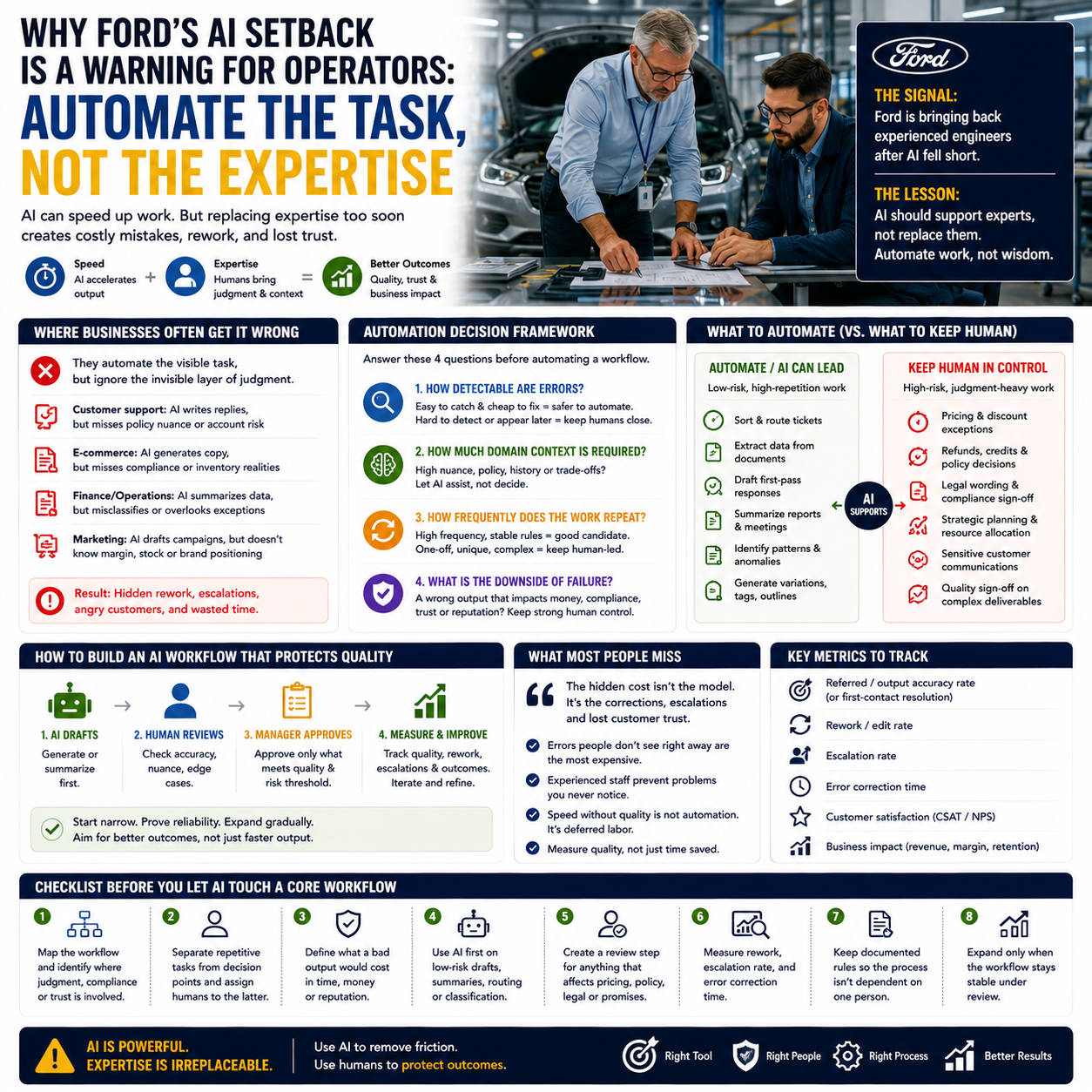
Ford’s decision to bring back experienced engineers after AI fell short is a useful business signal, not just an auto-industry headline. It points to a mistake many founders and operators are now making: treating AI as a shortcut around expertise instead of a tool that supports it.
For small businesses, the practical question is not whether to use AI, but where it can safely remove repetitive work without degrading quality. That distinction matters most in operations where mistakes are expensive, customer-facing, or hard to detect until after the damage is done.
What Ford’s move really says about AI adoption
The core lesson is simple: AI can accelerate output, but it does not automatically produce good output. In work that depends on judgment, tacit knowledge, domain context, or careful review, replacing experienced people too quickly creates hidden rework.
That is especially relevant for founders who are evaluating AI tools for product documentation, customer support, planning, compliance checks, content production, and internal analysis. The question is not whether a model can generate something fast. The question is whether the business can afford the errors that follow when no one with deep experience is still in the loop.
Ford’s example is valuable because it pushes operators to think in terms of workflow design. AI should often be used upstream for sorting, drafting, summarizing, routing, and pattern detection, while a human expert handles exceptions, final decisions, and quality control.
Where small businesses are most likely to get this wrong
The most common mistake is automating the visible task while ignoring the invisible layer of judgment underneath it. A prompt-based tool may write a support reply, but it will not understand refund policy nuance, account risk, or the commercial trade-off between speed and retention.
That same problem shows up in other functions:
In e-commerce, AI can generate product copy, but it may miss compliance language, variation differences, or merchandising priorities.
In finance and operations, AI can summarize spend, but it may misclassify transactions or overlook exceptions that affect cash planning.
In marketing, AI can draft campaigns, but it may not know which promotions should be suppressed for margin reasons or inventory constraints.
In all of these cases, the real asset is not the text or output itself. It is the domain logic behind the output.
What to automate first, and what to keep human
A better adoption model is to split work into three layers: repetitive tasks, judgment calls, and accountability. AI is strongest in the first layer, useful as support in the second, and weak in the third.
Use AI first where errors are easy to catch and cheap to correct. That includes categorizing tickets, extracting data from documents, drafting internal summaries, generating first-pass responses, and identifying anomalies for review.
Keep human ownership where the decision changes money, risk, or trust. That includes pricing exceptions, credit decisions, legal wording, brand-sensitive communication, strategic planning, and quality sign-off on complex work.
What most people miss
The hidden cost of bad AI implementation is not just an obvious mistake. It is the ongoing drain from corrections, escalations, customer trust repair, and employee frustration. If a system saves 30 minutes but creates 90 minutes of clean-up, it is not automation. It is deferred labor.
Founders should also remember that experienced staff are often not just doing the task. They are preventing downstream issues that junior workers and models do not see. Removing them too early can make the process look efficient while making the business less resilient.
A decision framework founders can actually use
Before replacing or augmenting a workflow with AI, assess the task against four questions. If you cannot answer them clearly, the process is probably not ready for full automation.
First, how detectable are errors? If mistakes are obvious and cheap to fix, AI can be helpful. If errors are subtle or appear weeks later, keep a stronger human review layer.
Second, how much domain context is required? If the task depends on policy nuance, client history, product specifics, or operational trade-offs, AI should assist rather than decide.
Third, how frequently does the work repeat? Repeated work with stable rules is a better automation candidate than one-off judgment-heavy work.
Fourth, what is the downside of failure? If a wrong answer affects revenue, compliance, customer retention, or reputation, the control system matters more than raw speed.
How to build an AI workflow that does not break quality
The safest approach is usually to redesign the process around review, not replacement. That means the model produces a draft, a human checks for accuracy and fit, and the final owner remains accountable.
For small teams, a practical workflow can look like this: AI drafts or sorts, a specialist reviews edge cases, and the manager approves only the items that cross a risk threshold. This keeps throughput high without turning expertise into a black box.
Another useful pattern is to start with narrow use cases. If AI is handling internal classification or note summarization reliably, expand from there. If it struggles with one category, fix the rule set or keep that category human-managed.
Founders should also track process quality, not just speed. If the number of edits, escalations, or customer corrections rises after AI deployment, the system is probably optimizing the wrong metric.
Checklist before you let AI touch a core workflow
- Map the workflow and identify where judgment, compliance, or customer trust is involved.
- Separate repetitive tasks from decision points and assign humans to the latter.
- Define what a bad output would cost in time, money, or reputation.
- Use AI first on low-risk drafts, summaries, routing, or classification.
- Create a review step for anything that affects pricing, policy, legal wording, or customer commitments.
- Measure rework, escalation rate, and error correction time after implementation.
- Keep documented rules so the process is not dependent on one employee remembering the edge cases.
- Expand only when the workflow stays stable under review.