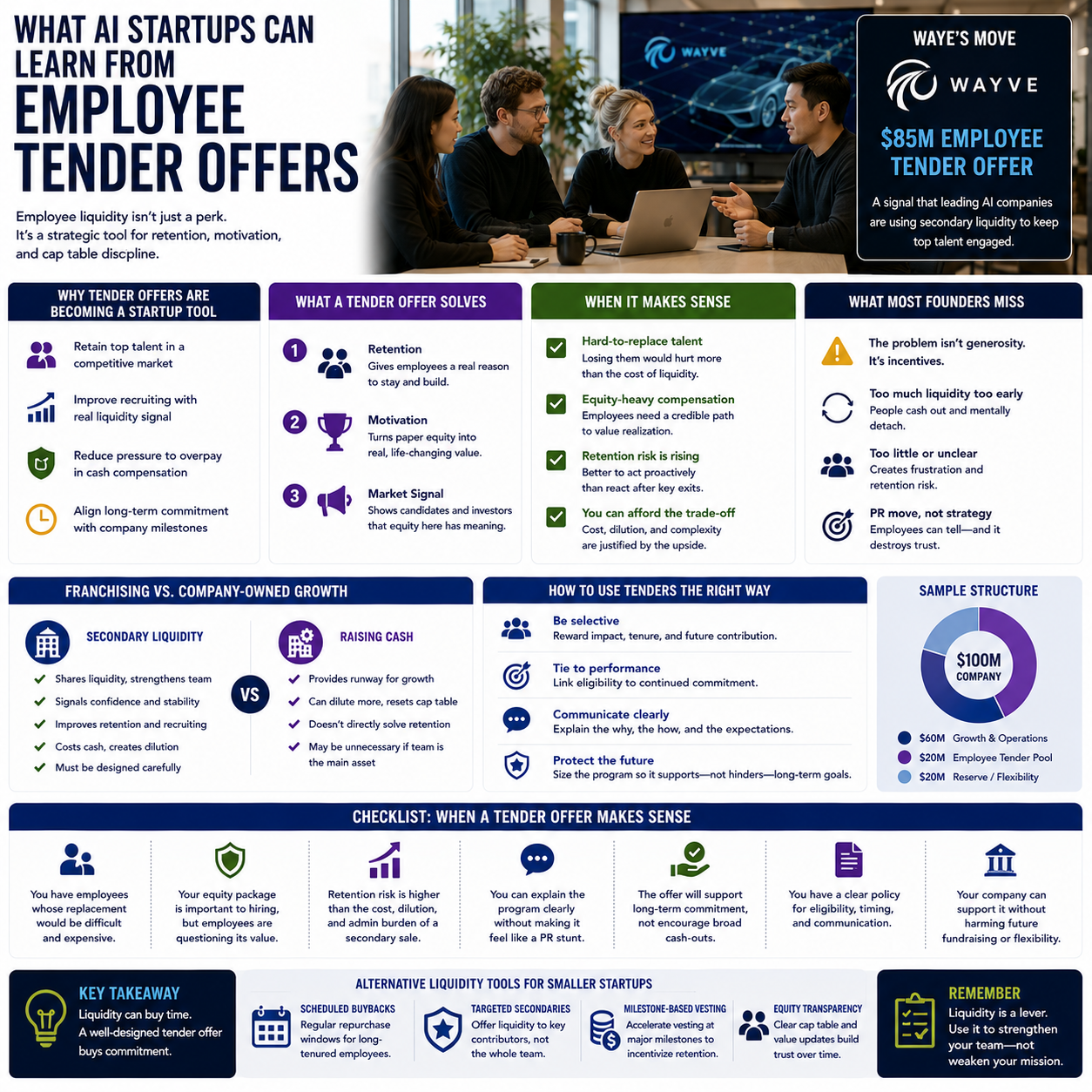
AI startups are using employee tender offers for a reason that has little to do with hype and a lot to do with operator math: retention, motivation, and cap table discipline. Wayve’s new $85 million employee tender offer is a useful signal for founders deciding whether to raise, hold, or create liquidity without a full funding round.
For small teams building in AI, this is not just a “good news for employees” story. It is a decision about how to keep senior talent engaged when the public market is unavailable, private equity is expensive, and compensation alone may not solve retention pressure.
Why employee tenders are becoming a startup tool
Wayve’s tender offer sits inside a broader pattern: high-growth AI companies are using secondary liquidity as a strategic tool to keep teams intact. That matters because the most valuable employees in frontier AI are often the ones most likely to receive outside offers, have paper wealth tied up for years, and expect some path to realization before an exit event.
For founders, the strategic question is not whether tenders are “nice.” It is whether your company has reached a point where retention risk is larger than the dilution or cash cost of creating liquidity. In AI, that threshold can arrive earlier than in traditional software because the hiring market is tighter, the work is more specialized, and the competitive pressure on top engineers is intense.
What a tender offer solves that salary does not
A salary increase helps with monthly cash flow. A tender offer changes the employee’s view of whether the equity has real value now. That distinction matters in startups where a large portion of compensation is equity-heavy and the time to exit can feel indefinite.
For operators, a secondary sale can solve three problems at once:
First, it can reduce retention risk by giving employees a credible reason to stay. Second, it can improve recruiting by making the company’s equity package feel less theoretical. Third, it can lower pressure to overpay in cash just to match market anxiety.
But the benefit only exists if the company uses the program carefully. If too much liquidity is offered too early, you can create the wrong incentive: people sell, cash out, and mentally detach. If too little is offered, the program becomes noise and can even create resentment.
How founders should judge whether secondary liquidity fits
Secondary liquidity should be treated like any other finance and operations decision: as a trade-off. Founders should ask whether the company is solving a retention problem, a morale problem, or a signaling problem. Those are related, but they are not the same.
A retention-driven tender is most defensible when the company has a hard-to-replace team, long product cycles, and meaningful outside demand for the same talent. A morale-driven tender makes sense when employees have been carrying extended execution risk without any path to realization. A signaling-driven tender is useful when the company wants to show it can support long-term commitment without forcing everyone to wait for acquisition or IPO.
Where founders get into trouble is treating liquidity as a PR move. Once employees believe a tender is happening mainly to create a headline, the operational value drops. The program should be tied to a real people strategy and a real cap table strategy.
What most people miss
The real issue is not whether employee liquidity is generous. It is whether it changes behavior in the direction the company wants. If your best people are staying only because they hope for a distant exit, you do not have a retention strategy; you have a delay strategy. A limited secondary program can be a healthier answer than raising cash just to defend morale.
What this means for smaller founders outside AI
Most founders will not run an $85 million tender offer. That does not make the signal irrelevant. It shows that private companies increasingly treat liquidity as an operating lever, not just a late-stage perk.
If you run a small business, e-commerce company, or software startup, the practical lesson is to think in terms of employee trust and ownership clarity. If the equity story is unclear, people discount it. If there is no path to liquidity at all, the company may end up spending more on replacement hiring than it would have spent on a targeted retention solution.
For smaller teams, that can mean narrower programs: selective grants, scheduled repurchase windows, or carefully structured secondary sales for long-tenured employees. The point is not to copy a late-stage AI company. The point is to decide whether your company’s equity plan actually supports the behaviors you need.
How to avoid creating a bad incentive loop
Secondary offers can backfire if they are not linked to performance, tenure, and future commitment. Founders should avoid making liquidity feel random or purely status-based. If employees think the most important thing is timing their sale rather than building the company, you have weakened the internal operating system.
That is why tender offers should be paired with clear communication about who is eligible, why the offer exists, and what the company expects next. The goal is to reward commitment without signaling that the company is entering a wind-down phase.
There is also a finance discipline here. Every liquidity event has a cost, whether it comes from company cash, investor participation, or administrative complexity. Founders should compare that cost with the cost of turnover, lost institutional knowledge, and the distraction of constant compensation negotiations.
Checklist: when a tender offer makes sense
- You have employees whose replacement would be difficult and expensive.
- Your equity package is important to hiring, but employees are beginning to question its real value.
- Retention risk is higher than the cash, dilution, and administrative cost of a limited secondary sale.
- You can explain the purpose of the program in plain terms without making it feel like a PR stunt.
- The offer will be selective enough to support long-term commitment, not encourage broad disengagement.
- You have a clear internal policy for eligibility, timing, and communication.
- Your company can support the program without harming operating flexibility or future fundraising.