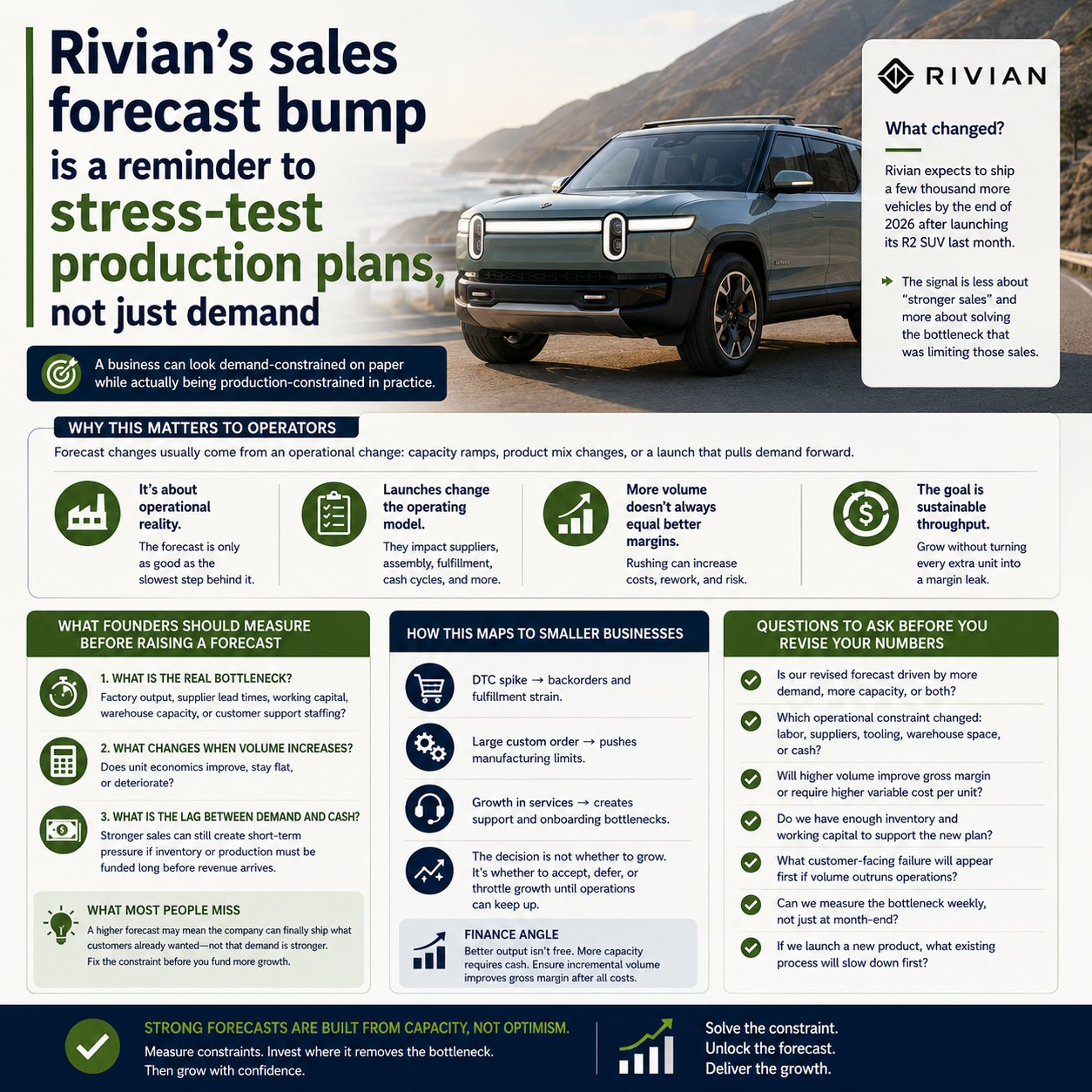
Rivian’s higher sales forecast is not just an EV story. It is a reminder that a business can look demand-constrained on paper while actually being production-constrained in practice. For founders and operators, the useful question is not whether the market is optimistic, but whether your own supply, cash, and launch plans can keep up.
Why this matters to operators
According to the TechCrunch report, Rivian expects to ship a few thousand more vehicles by the end of 2026 than it previously planned after launching its R2 SUV last month. That shift matters because forecast changes like this usually come from a specific operational change: capacity ramps, product mix changes, or a launch that pulls demand forward. In other words, the signal is less about “stronger sales” and more about whether the business has solved the bottleneck that was limiting those sales.
That is a useful lens for any founder. A revised forecast can hide a lot of operational reality: better factory output, higher component availability, improved quality yield, or simply a more realistic view of what the business can actually ship. If you run an e-commerce brand, a hardware startup, or a subscription business with physical fulfillment, the same logic applies. The forecast is only as good as the slowest operational step behind it.
What changed in Rivian’s case
The immediate trigger was the launch of the R2 SUV. That matters because new product launches often change the whole operating model. They can affect supplier commitments, assembly sequencing, dealer or direct-to-customer fulfillment, marketing timing, and cash conversion cycles. A launch is not just a product event; it is an operating test.
For a business builder, the practical question is whether a launch increases total throughput or merely shifts volume from one product line to another. If you sell multiple SKUs, a new launch can create a flattering forecast while actually straining operations elsewhere. You may sell more units overall but still damage margin if rush production, expedited freight, or quality rework rises at the same time.
What founders should measure before raising a forecast
When a company decides to revise expectations upward, the useful discipline is to tie the forecast to measurable operating constraints. That means checking whether the business can sustain volume without turning every extra unit into a margin leak.
Three questions matter most:
First, what is the real bottleneck? It may be factory output, supplier lead times, working capital, warehouse capacity, or customer support staffing. Second, what changes when volume increases: does unit economics improve, stay flat, or deteriorate? Third, what is the lag between demand and cash? A stronger sales outlook can still create short-term pressure if inventory or production has to be funded long before revenue arrives.
For physical products, this is where many forecasts fail. Teams model demand from marketing signals, then discover too late that the supply chain cannot absorb it. The more useful forecast is built from capacity, not optimism.
What most people miss
The most common mistake is treating a higher forecast as evidence that demand is stronger, when it may actually mean the company is finally able to ship what customers already wanted. That difference matters because it changes the decision. If demand was already there, the work is not “find more customers”; it is “remove the constraint that blocked fulfillment.”
That distinction changes how you spend money. You invest differently if the constraint is tooling, labor, suppliers, software, or inventory financing. A founder who misreads the signal often allocates budget to growth before fixing the operating choke point.
How this maps to smaller businesses
Most small businesses do not build vehicles, but they do face similar problems when a product line starts to scale. A DTC brand can hit the same wall when a TikTok-driven spike turns into backorders. A manufacturer can see the same pattern when one custom order wins a large account. A SaaS company with onboarding services can run into it when growth creates a support bottleneck.
The decision is rarely whether to grow. It is whether growth should be accepted now, deferred, or throttled until operations catch up. If your team cannot explain the capacity limits in plain numbers, the forecast is probably too loose. If your team can explain them and still revise guidance upward, that is a sign the business has crossed from hope-based planning to operational planning.
There is also a finance angle. Better production or fulfillment is not free. If the forecast improves because the company has invested in capacity, the real question is whether incremental volume is improving gross margin after all related costs. Growth that depends on overtime, expediting, and scrap reduction is not the same as growth from a stable process.
Questions to ask before you revise your own numbers
- Is our revised forecast driven by more demand, more capacity, or both?
- Which operational constraint changed: labor, suppliers, tooling, warehouse space, or cash?
- Will higher volume improve gross margin or require higher variable cost per unit?
- Do we have enough inventory and working capital to support the new plan?
- What customer-facing failure will appear first if volume outruns operations?
- Can we measure the bottleneck weekly, not just at month-end?
- If we launch a new product, what existing process will slow down first?


