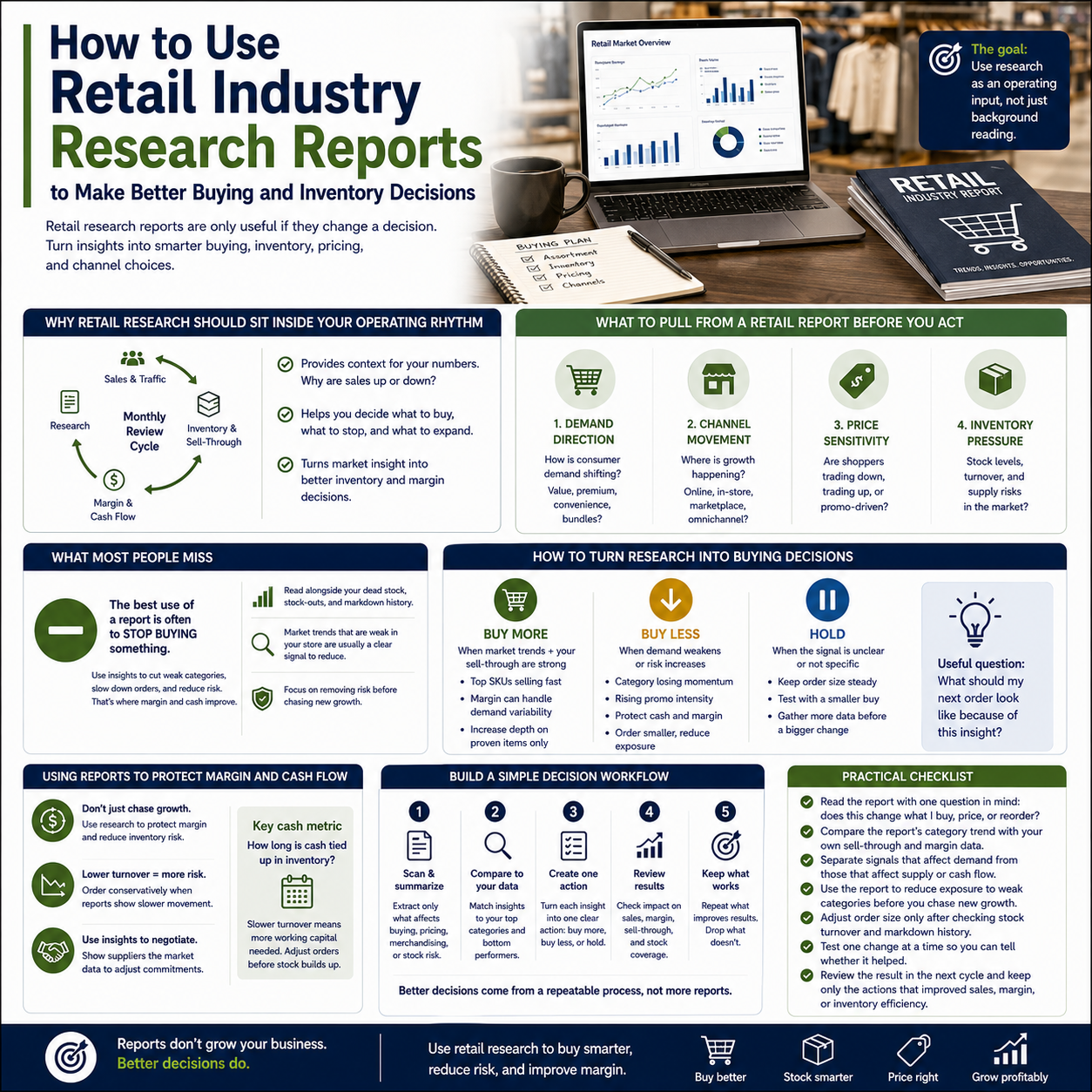
Retail research reports are only useful if they change a decision. For founders and operators, the real value is not reading the market summary, but translating it into buying, inventory, pricing, and channel choices. This article focuses on how to use those reports as operating inputs, not as background reading.
Why retail research should sit inside your operating rhythm
Most small retailers treat industry reports as occasional reading material. That approach leaves the information disconnected from the decisions that actually move cash: what to reorder, which categories to expand, which products to stop buying, and where demand is softening.
A better approach is to place retail research into your monthly review cycle alongside sales, gross margin, sell-through, and stock coverage. The report does not replace your internal data. It gives context for why your numbers are moving and whether the change is company-specific or market-wide.
If your category is slowing but your traffic is stable, the issue may be product mix. If the market is accelerating but your sell-through is lagging, the issue may be merchandising, pricing, or replenishment speed. That distinction is what makes a report useful.
What to pull from a retail report before you act
Not every section of a report deserves attention. Small businesses should focus on four practical signals:
Demand direction. Look for category trends that affect your assortment. Is demand shifting toward value, premium, convenience, or bundled offers? This helps you decide whether your current mix is aligned or stale.
Channel movement. If a report shows stronger activity in online, in-store, marketplace, or omnichannel behavior, it can guide how you allocate inventory and fulfillment attention.
Price sensitivity. Reports often reveal where consumers are trading down or trading up. That matters for markdown planning, promo timing, and whether your margin structure can absorb discounting.
Inventory pressure. When reports point to higher stock levels, slower turnover, or supply volatility, that should feed directly into order quantity and safety stock decisions.
What most people miss
The best use of a research report is often to stop buying something, not to buy more. Many retailers read reports looking for a growth signal, but the faster margin improvement often comes from removing categories that are losing relevance, buying less into uncertain demand, or reducing reorder frequency on slow movers.
That means the report should be read alongside your dead stock list, stock-out data, and markdown history. If a category looks good in the market but underperforms in your store, the problem may be assortment depth, pricing, or audience fit. If a category looks weak in the market and weak in your store, that is usually a clean candidate for reduction.
How to turn research into buying decisions
Retail research becomes operational when it changes purchase orders. Start by mapping each insight to one of three actions: buy more, buy less, or hold.
Buy more only when the report aligns with your own sell-through data and you have enough margin to cover demand variability. For example, if a category is gaining share and your top SKUs are turning quickly, increase depth only on proven items, not on every product in the line.
Buy less when the report suggests weakening demand, rising promo intensity, or soft consumer sentiment in your price band. This is especially important if your cash is tied up in inventory with long holding periods.
Hold when the report is directional but not specific enough to justify a change. In that case, keep your order size steady and test with a smaller purchase instead of making a blanket change across the assortment.
The useful question is not, “What is the market doing?” It is, “What should my next order look like because of this?”
Using reports to protect margin and cash flow
Retail operators often treat market research as a growth tool, but it is just as valuable as a risk-control tool. If a report suggests that consumers are moving toward lower-priced alternatives, your first response may not be a new marketing campaign. It may be a margin reset.
That can mean adjusting pack sizes, simplifying the assortment, tightening reorder points, or reducing exposure to products that require steep markdowns to move. It may also mean renegotiating with suppliers when you can show that demand is weaker than expected or that your inventory commitment should be smaller.
For cash flow, the key metric is how long money stays trapped in stock. Reports that signal slower turnover should trigger more conservative ordering, not optimism. If you are running a lean business, even a modest change in sell-through can alter your need for working capital.
When the report and your internal data disagree, trust your numbers first. The report gives the market frame, but your customer behavior is the final proof.
How to build a simple decision workflow around retail research
You do not need a complex system to make reports useful. A small business can turn them into a repeatable workflow with a few rules.
First, assign one person to scan new reports and summarize only the points that affect buying, pricing, merchandising, or stock risk. Second, compare those points to your top-selling categories and your bottom performers. Third, create one action item per insight, not a general plan. Fourth, review whether the action changed sales, margin, or stock coverage after the next cycle.
This workflow matters because it prevents “report reading” from becoming a passive habit. The goal is not to collect insights. The goal is to decide faster and with less guesswork.
A practical checklist for founders and retail operators
- Read the report with one question in mind: does this change what I buy, price, or reorder?
- Compare the report’s category trend with your own sell-through and margin data.
- Separate signals that affect demand from signals that affect supply or cash flow.
- Use the report to reduce exposure to weak categories before you chase new growth.
- Adjust order size only after checking stock turnover and markdown history.
- Test one change at a time so you can tell whether the report-led decision helped.
- Review the result in the next planning cycle and keep only the actions that improved sales, margin, or inventory efficiency.