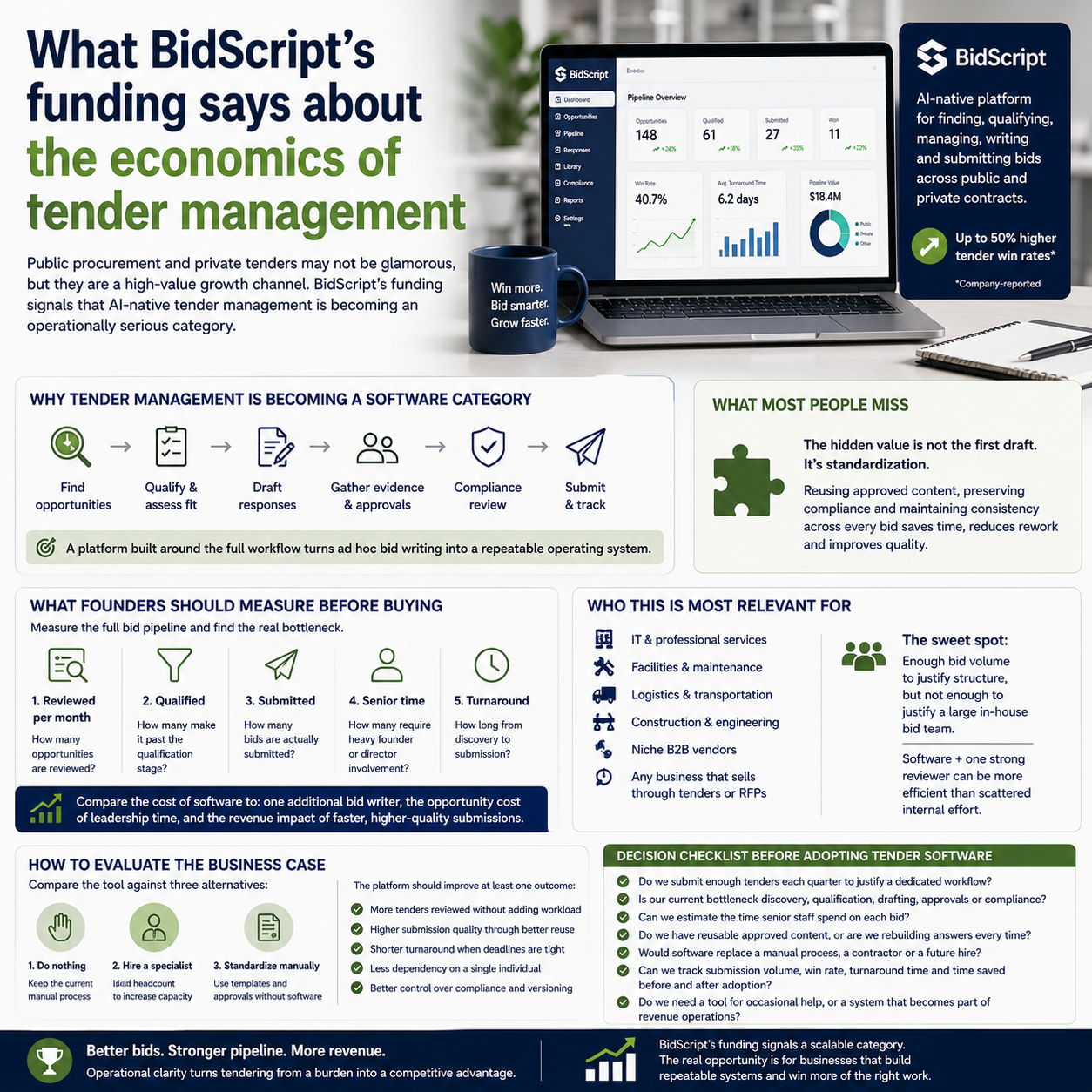
Public procurement and private tenders are one of the least glamorous growth channels in business, but for many operators they are among the most valuable. BidScript’s new funding round is a signal that the market for software that finds, qualifies and drafts bids is moving from “nice to have” into a more operationally serious category.
The interesting question for founders and revenue teams is not whether AI can help write bids. It is whether the economics of bidding justify a dedicated system, a specialist hire, or a hybrid process built around automation.
Why tender management is becoming a software category
BidScript describes itself as an AI-native tender management platform for finding, qualifying, managing, writing and submitting bids across public and private contracts. That matters because tendering is not a single task. It is a workflow with several separate cost centers: opportunity discovery, eligibility checks, response drafting, approvals, evidence gathering, compliance review and submission.
For small and mid-sized businesses, those steps often sit across sales, operations, finance and leadership. The result is slow turnaround, fragmented ownership and a hidden cost in senior time. A platform built around the full workflow can change the process from ad hoc bid writing into a repeatable operating system.
BidScript also says it has seen up to 50% higher tender win rates. That claim should be treated as company-reported, not a benchmark to assume across the market. But even without using that number as a forecast, it points to the core operator question: if the platform improves speed, relevance and compliance, how many more bids can a small team submit without increasing headcount?
What founders should actually measure before buying
The wrong way to evaluate tender software is to ask whether it “uses AI.” The right way is to measure the full bid pipeline and where the bottleneck sits.
Start with five numbers:
- How many opportunities are reviewed per month.
- How many make it past qualification.
- How many are actually submitted.
- How many require heavy founder or director involvement.
- How long a typical bid takes from discovery to submission.
If the team is reviewing many tenders but submitting few, the issue may be qualification, not writing. If submissions are happening but quality is inconsistent, the issue may be document reuse, approvals or compliance. If a founder is still the final bottleneck on every response, the real cost is senior time, not copywriting.
This is why a tender platform can be a finance decision as much as a sales decision. It should be compared against the cost of one additional bid writer, the opportunity cost of leadership time and the revenue value of faster submission cycles.
What most people miss
The hidden value in tender tools is not the first draft. It is standardization. Most businesses lose efficiency because every bid starts from scratch: different file names, different evidence, different terminology and different approval paths.
That creates a process problem, not just a writing problem. If an AI system can pull approved company content, assemble responses from a controlled library and preserve formatting and compliance checks, it may reduce the amount of rework across the whole pipeline. For operators, that is where the return becomes visible.
It also changes the make-or-buy decision. A business that wins only occasional contracts may not need a dedicated bid team. A company that bids repeatedly in regulated or process-heavy markets may find that software plus one strong reviewer is cheaper than relying on scattered internal effort.
Who this is most relevant for
This is not only a procurement-tech story. It is relevant to any business that sells through tenders, framework agreements, vendor onboarding processes or formal RFPs. That includes IT services firms, facilities providers, logistics operators, professional services firms, construction suppliers and niche B2B vendors trying to enter enterprise accounts.
The strongest use case is usually a business that has enough bid volume to justify structure but not enough volume to justify a large in-house team. Those companies often have the same problem: they know they can win more work, but the response process is too manual to scale.
In that context, AI-native tender software is less about replacing expertise and more about preserving it in reusable form. The most valuable institutional knowledge in a bid team is often buried in old submissions, case studies, reference answers and qualification notes. If the platform makes that content searchable and reusable, it can reduce the dependency on one or two senior people.
How to evaluate the business case without getting lost in the pitch
Operators should avoid buying on promises of “faster” or “smarter” alone. Instead, compare the tool against three alternatives: doing nothing, hiring a bid specialist, or standardizing the current process with shared templates and approvals.
The real decision is whether the platform changes one of these outcomes:
- More tenders reviewed without adding workload.
- Higher submission quality through better reuse of approved content.
- Shorter turnaround when deadlines are tight.
- Less dependency on a single founder or commercial lead.
- Better control over compliance and versioning.
If a tool does not improve at least one of those outcomes, it is probably a convenience layer rather than an operational asset.
BidScript’s funding round suggests investors see tender automation as a scalable category, not a niche document tool. For founders and operators, the practical question is simpler: can this system help us bid more consistently, with less senior drag, and with a clearer path to measurable revenue?
Decision checklist before adopting tender software
- Do we submit enough tenders each quarter to justify a dedicated workflow?
- Is our current bottleneck discovery, qualification, drafting, approvals or compliance?
- Can we estimate the time senior staff spend on each bid?
- Do we have reusable approved content, or are we rebuilding answers every time?
- Would software replace a manual process, a contractor or a future hire?
- Can we track submission volume, win rate, turnaround time and time saved before and after adoption?
- Do we need a tool for occasional help, or a system that becomes part of revenue operations?