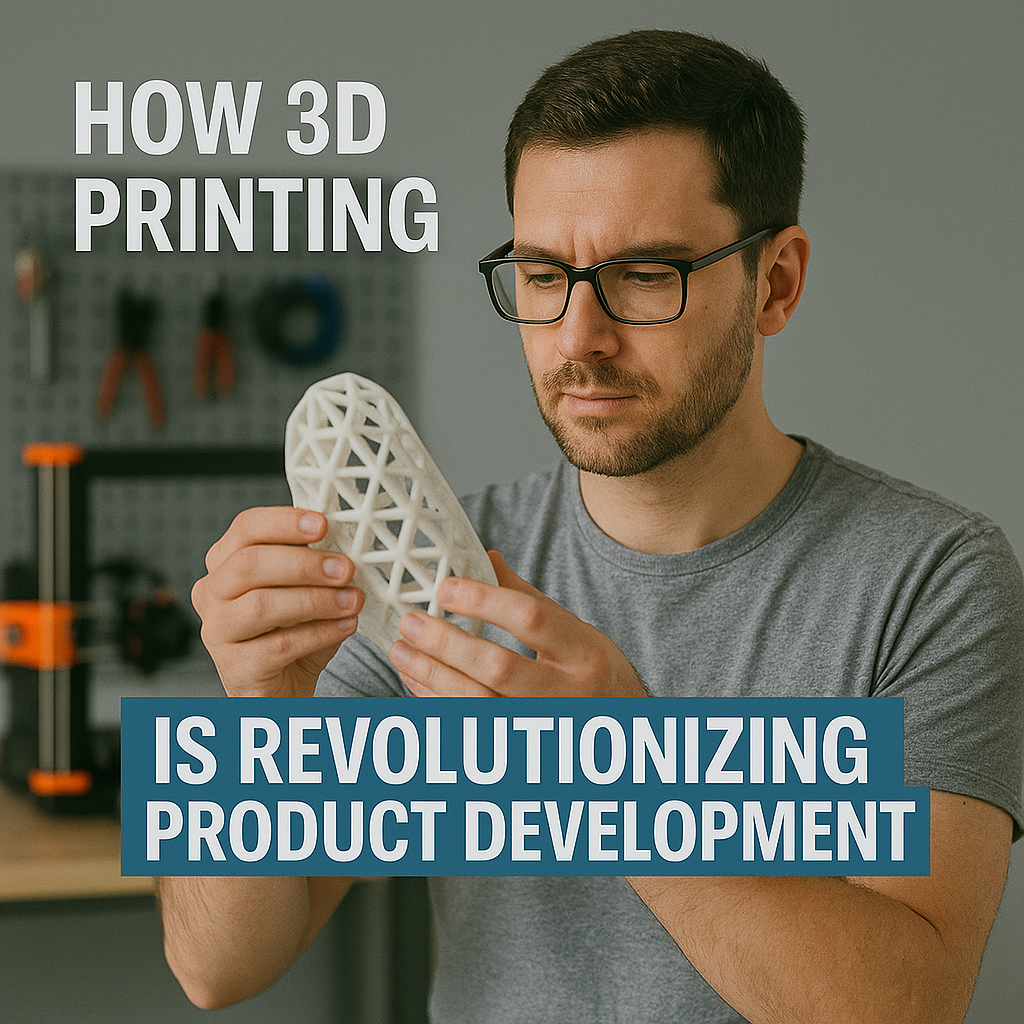
3D printing can help a product team learn from a physical model before committing to production tooling. Its business value depends on the question the prototype answers, the process and material used, and the total effort required. It is not automatically the fastest or cheapest manufacturing method.
This guide covers choosing a prototyping approach. For a documented build-and-test cycle, use the 3D-printed prototype acceptance worksheet.
Choose the prototype’s job
A visual model, an ergonomic mock-up, an assembly-fit check and a functional test part serve different purposes. Define which question must be answered before selecting a printer or supplier. A model that proves appearance may provide no evidence of production strength or durability.
| Question | Useful evidence | Limitation to record |
|---|---|---|
| Does the shape fit the user’s hand? | Observed use of a representative mock-up | Material and weight may differ from production |
| Do two components assemble? | Measured dimensions and assembly trial | Prototype tolerances may differ from the final process |
| Does the part withstand an intended load? | Qualified testing of the relevant material and process | A successful shape check does not prove performance |
Compare printing with other routes
Request alternatives where appropriate: a purchased sample, a simple mock-up, machining or another fabrication process may answer the same question. Compare lead time, design preparation, post-processing, testing, shipping and the probability of another iteration.
For an illustrative small project, a low print quote can still be a poor choice if extensive finishing or a second outsourced test is required. Compare the cost of reaching an accepted learning result, not only the cost of producing an object.
Decide whether to buy equipment or use a service
Consider how often prototypes are needed, whether the team can operate and maintain the equipment, and what material or process capability is required. Include workspace requirements, training, consumables, failed builds and inspection. A service can be useful for testing demand before committing to equipment, but its lead time and confidentiality arrangements still matter.
Separate prototype approval from production release
Record which properties the model demonstrates and which remain untested. Material, orientation, process settings and post-processing can affect the result. NIST’s part-qualification work explains measurement challenges involving geometry, defects and mechanical performance.
For safety-critical or regulated applications, use competent specialists and the applicable qualification process. A prototype demonstration does not establish that a medical, aerospace or other critical part is suitable for use.
Approve a learning plan
Assign the decision owner, test question, acceptance evidence, budget and iteration limit. Retain failed results as well as successful models. The next step should follow from the evidence: revise the design, change the process, obtain a different test or proceed to the next development stage.
Connect the work to measurable product milestones and explore the Technology guides.