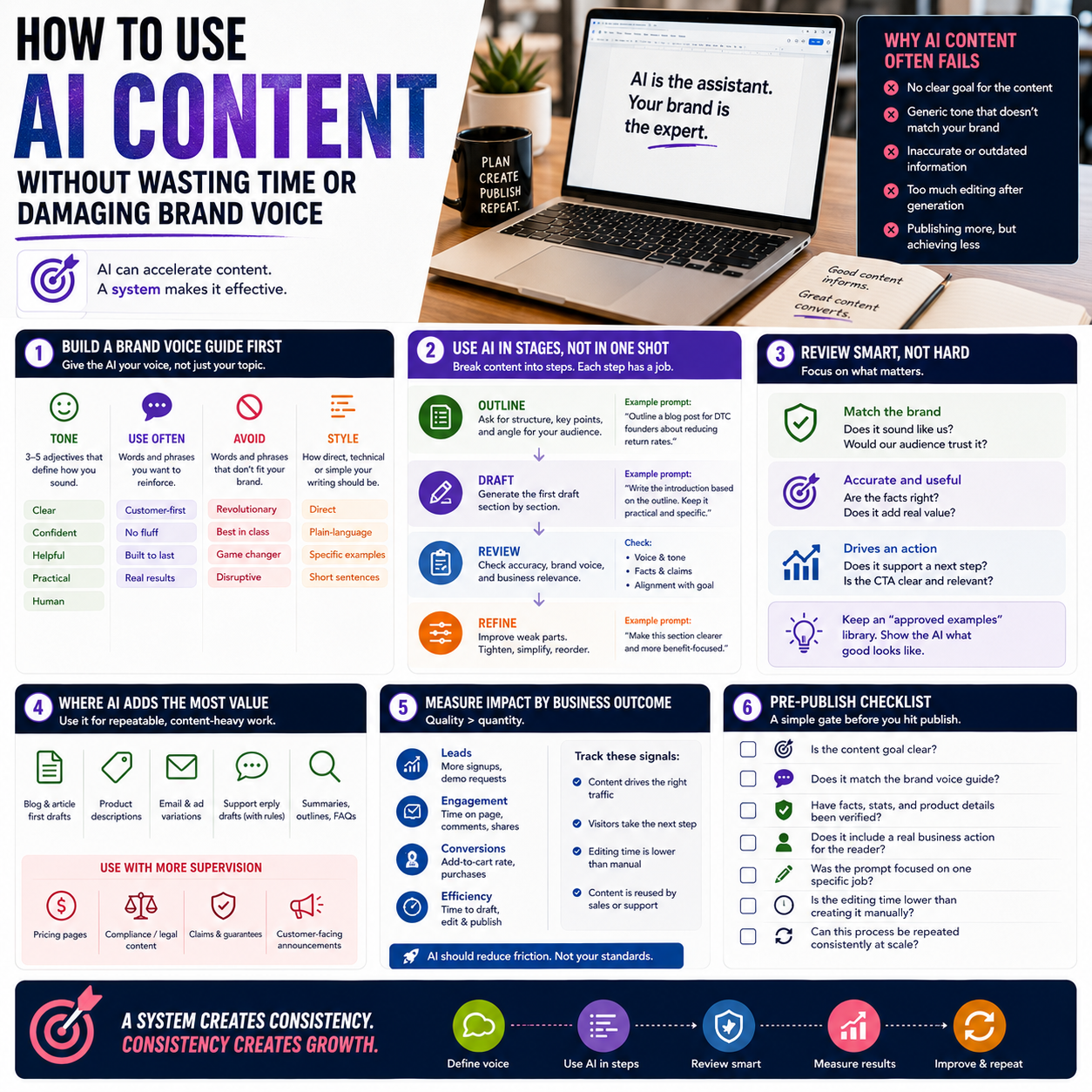
AI can speed up content production, but speed alone does not create useful marketing. For small businesses, the real issue is not whether to use AI — it is whether the workflow produces content that sounds like the brand, supports sales, and avoids repetitive mistakes.
The strongest approach is not “write with AI” but “build a controlled content system with AI.” That means defining the voice first, using repeatable prompts, and putting human review in the right place so you do not spend more time fixing low-quality output than you saved generating it.
Why AI content fails in small business operations
The most common failure is not technical. It is operational. Businesses plug a tool into content creation without defining what the output must do. As a result, the content may be grammatically fine but still fail on tone, accuracy, positioning, or conversion.
That creates hidden cost. A founder or marketer can publish more posts, but if each draft needs major rewriting, the process becomes slower and more expensive than a traditional content workflow. In e-commerce and service businesses, the risk is even sharper because bad content can misstate product details, overpromise results, or weaken trust.
Before scaling AI output, a business should answer one question: what job is this content supposed to do? If the answer is vague, the model will fill the gap with generic language that sounds polished but does not help the business.
Build a brand voice guide before you write prompts
The most useful control layer is a brand voice guide. This does not need to be a long document. It needs to tell the AI what the brand sounds like, what it avoids, and how it handles repeated situations such as objections, product explanations, and calls to action.
A strong voice guide usually includes:
- Three to five adjectives that define the tone.
- Words and phrases the brand uses often.
- Words and phrases the brand avoids.
- How direct the writing should be.
- How technical or plain-language the content should feel.
For example, a B2B software company may want concise and specific language, while a consumer brand may want warmer and more conversational phrasing. Without this layer, AI tends to default to broad marketing language that makes every business sound similar.
What most people miss
Most teams treat prompt writing as the main skill. It is useful, but the bigger lever is the review process. A well-written prompt can still produce content that is factually thin, too generic, or off-brand if nobody checks it against business standards.
Human review should not mean line-by-line rewriting. It should mean checking three things: does this match the brand voice, is it accurate, and does it support the intended business outcome? That keeps the review stage focused and prevents content teams from wasting time polishing text that should have been redirected earlier.
The best teams also keep a small library of approved examples. These examples teach the model what “good” looks like faster than abstract instructions do. In practice, that often improves consistency more than adding more prompt detail.
Use prompts as a workflow, not as a one-off request
One prompt is rarely enough for useful output. A better process is to break content creation into stages: outline, draft, review, and refine. Each stage should ask the model to do one job well instead of asking for a complete, finished article in a single pass.
This matters because AI tools are better when the task is narrow. A prompt that asks for an outline with a specific audience, purpose, and content angle is usually more useful than a broad request for “a blog post about customer experience.” The narrower workflow makes it easier to catch weak logic before the draft becomes long and harder to edit.
For operators, this also helps with delegation. A marketer can own the structure, a founder can check the business claims, and an editor can enforce voice. The result is a process that is easier to repeat and easier to measure.
Track content performance by business outcome, not volume
If AI makes it possible to produce more content, the wrong response is to celebrate output volume. The better question is whether the content supports a measurable business outcome. That outcome may be email signups, demo requests, add-to-cart rate, qualified traffic, or lower time spent drafting internal materials.
Small businesses should monitor a few practical indicators rather than too many vanity metrics. If content is meant to attract leads, check whether it brings in the right traffic and whether those visitors move into the next step. If content is meant to support sales, measure whether sales teams use it and whether it answers common objections better than the old version.
AI content also has a revision cost. If every article needs heavy editing, the workflow is not efficient. The goal is not only better content but less friction between idea, draft, review, and publication.
How to set up a safe and usable AI content process
The most practical setup is a controlled system with clear inputs and clear checks. That usually means a short voice guide, a prompt template, a review checklist, and a small set of content types that are allowed to be AI-assisted. Not every page or message should be treated the same way.
Some content is safe to automate more heavily, such as internal outlines, product description variations, or first-pass article drafts. Other content needs more supervision, such as pricing explanations, claims, legal wording, or customer-facing responses. The smarter the business is about this split, the more useful AI becomes.
What matters most is consistency. AI should reduce the time between idea and usable draft without weakening brand identity or creating avoidable corrections.
Use this checklist before publishing AI-assisted content
- Is the content goal clear: awareness, lead generation, sales support, or retention?
- Does the draft match a written brand voice guide?
- Have factual claims, product details, and names been checked by a person?
- Does the piece include a real business action, not generic advice?
- Did the prompt ask for one specific content job instead of everything at once?
- Is the editing time lower than the time it would take to create the content manually?
- Can this process be repeated across multiple articles or pages without quality dropping?