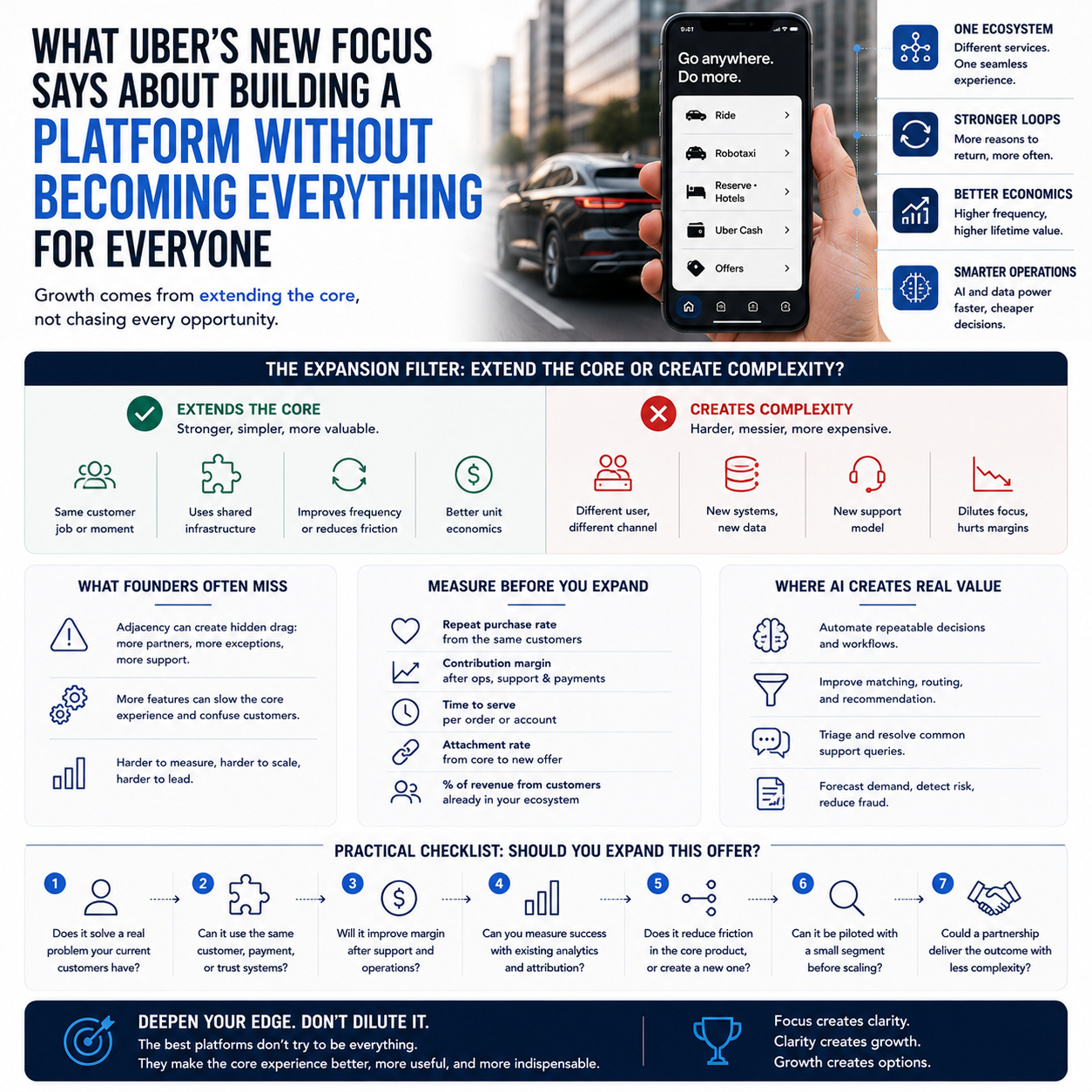
Uber’s product chief just outlined a familiar but hard lesson for operators: a platform can grow into adjacent revenue streams without turning into a catch-all business. That tension matters for founders, marketplace operators, and subscription businesses deciding whether to expand product scope or stay tightly focused.
The practical question is not whether a company can add more features. It is whether those features create a clearer operating system, a stronger repeat-use loop, and better economics without turning the product into a confusing bundle.
Why this matters for founders and operators
Uber’s push into hotels, robotaxis, financial services, and AI-enabled operations is not just a consumer-tech story. It is a reminder that expansion only works when the new line strengthens the core transaction engine. For smaller businesses, the same logic applies when deciding whether to add memberships, logistics, financing, software, or services on top of an existing offer.
The mistake many companies make is treating expansion as a branding move. They add a new feature because the market is large, not because the feature changes how often customers buy, how much they spend, or how expensive it is to serve them.
The real decision: extend the core or create complexity
Uber’s approach suggests a useful decision filter. If a new offer helps the same user complete a related job faster, with higher frequency or better margin, it may belong inside the platform. If it requires a different acquisition channel, a different support model, or a different operating team, it may be a separate business, not an extension.
For founders, that distinction affects capital allocation. A company with weak focus can end up with rising support costs, inconsistent brand positioning, and an analytics stack that does not cleanly measure one growth engine. A company with disciplined focus can build adjacent revenue lines that reinforce each other.
What most people miss
The strategic mistake is assuming “adjacent” always means “safe.” In reality, adjacent products often create hidden operational drag: more partner management, more exception handling, more customer-service pathways, and more product complexity in checkout, billing, and attribution.
That is why platform expansion should be judged on operating load, not just market size. A new product line that looks attractive in a deck can become expensive if it adds manual reviews, fragmented reporting, or support tickets that slow the core experience.
How to evaluate a new expansion idea
Start with the customer job. If you already have a high-frequency use case, ask whether the new line reduces friction in that same workflow. For Uber, that could mean transportation-adjacent services, travel booking, or payment-related utilities. For an e-commerce operator, it could mean subscriptions, replenishment, warranties, or B2B fulfillment.
Then map the operating stack. The best expansions often reuse existing assets: customer identity, payments, routing, logistics, trust systems, or data. If the new business requires entirely new systems and no shared unit economics, the expansion may be better handled through partnership than ownership.
What to measure before you expand
Before shipping a new line of business, founders should test whether it improves one of these metrics:
- Repeat purchase rate from the same customer cohort
- Contribution margin after support, payments, and operations
- Time to serve per order or per account
- Attachment rate from the core product into the new offer
- Share of revenue from customers already in the ecosystem
How to think about AI in the operating model
Uber’s comments also point to a broader trend: AI is showing up less as a headline feature and more as an operational layer. That matters because AI is most useful when it reduces decision time, improves matching, filters exceptions, or automates workflows behind the product.
For smaller companies, the opportunity is not to “add AI” in the abstract. It is to identify repeatable tasks that already consume human time: support triage, quote generation, fraud review, route planning, sales qualification, or inventory forecasting. If AI cannot be tied to a measurable process, it is likely just decoration.
A practical checklist for deciding whether to expand
- Does the new offer solve a problem your current customer already has?
- Can it use the same customer, payment, or trust infrastructure?
- Will it improve margin after support and operations, not just increase revenue?
- Can you measure success with existing analytics, or will attribution become unclear?
- Does it reduce friction in the core product, or create a second business with separate demands?
- Can the offer be piloted with a narrow segment before a full rollout?
- Would a partnership achieve the same outcome with less operational complexity?
For founders, the lesson is straightforward: expansion should make the core business easier to run, not harder to explain. The best platform moves do not chase every possible line of revenue. They deepen the operating logic of the business that already works.