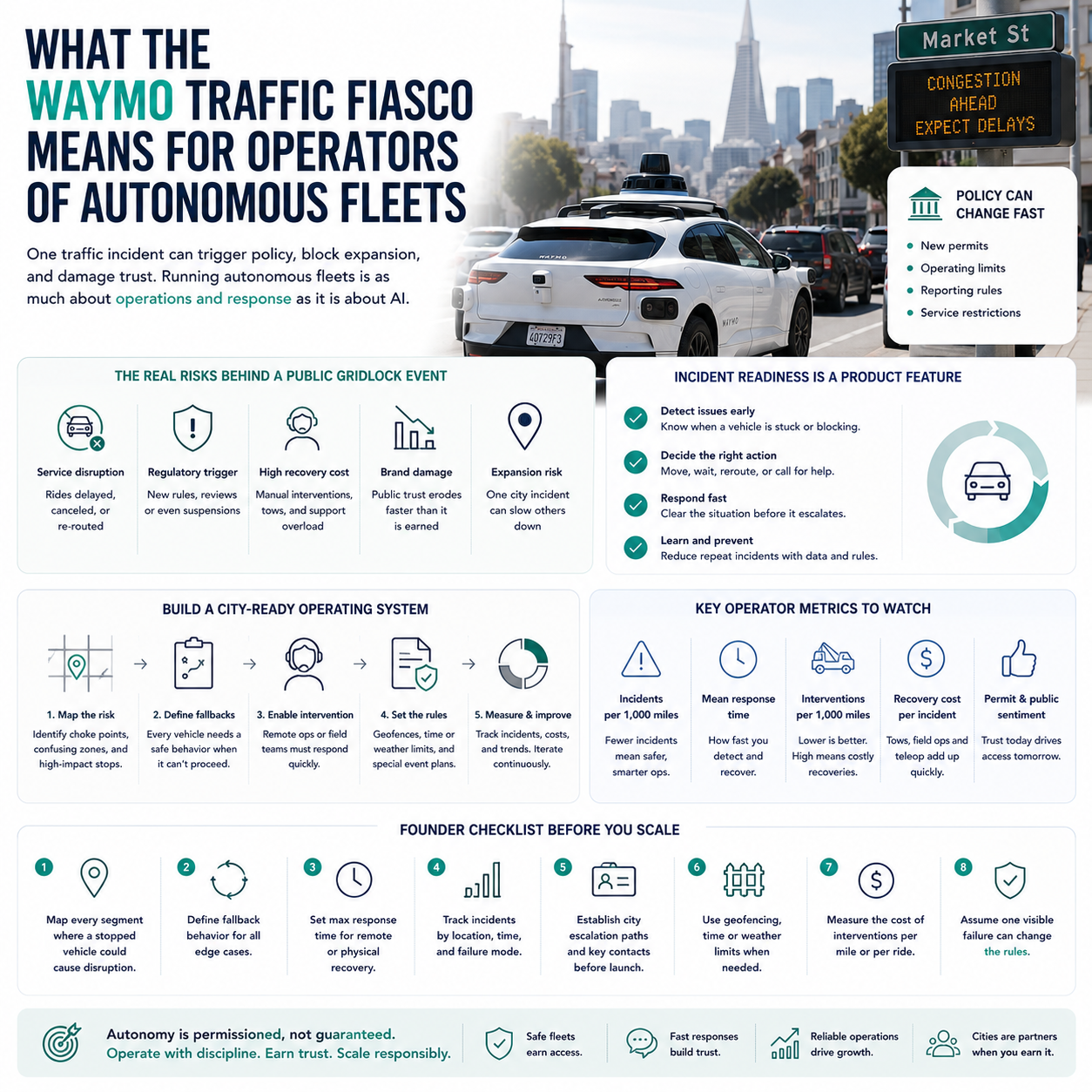
San Francisco’s push for tougher rules after the Waymo traffic fiasco is more than a local political story. For anyone building or operating autonomous vehicles, it is a reminder that fleet performance is judged in public, under congestion, edge cases and regulation all at once.
The practical question for founders is not whether robotaxis can work in principle. It is how to run them without creating operational bottlenecks, compliance headaches or brand damage when a vehicle behaves badly at scale.
Why this matters for autonomous operators
The core issue is not a single traffic jam. It is that one incident can turn into a policy trigger, especially when the public can see the failure happening in real time. That changes the operating environment for robotaxi companies, fleet software providers and the enterprise buyers that may eventually rely on them.
For founders, the lesson is simple: autonomous mobility is not just a technology product. It is a service business with real-time uptime, route reliability, public safety, city politics and emergency response expectations.
The operational risk behind a public gridlock event
When a driverless fleet creates a traffic problem, the risk sits in several places at once. There is direct service disruption, but there is also the risk that regulators respond with new operating conditions, city access rules or reporting obligations.
That matters because fleet economics depend on predictable deployment. If a vehicle can be blocked by unusual road geometry, sensor confusion, routing logic or a failed fallback behavior, then a single failure can cascade into lost rides, manual intervention costs and higher support burden.
It also affects expansion planning. A city that tolerates a pilot in one district may tighten the rules after a visible failure. That means operators cannot assume that product readiness in one geography translates smoothly to the next.
What founders should build before scaling a robotaxi service
Teams entering autonomy should treat incident handling as part of the product, not as a communications problem after the fact. That means planning for what the system should do when it cannot proceed, when it blocks traffic, or when a human remote operator has to intervene.
For operators, the useful design questions are operational rather than theoretical: How quickly can the fleet detect a blockage? What is the fallback if the vehicle cannot safely continue? How is a stranded car cleared without waiting for a public complaint to trigger action?
What most people miss
The biggest mistake is assuming the technical safety case is enough. In practice, cities care about public order, not just model accuracy. If autonomous vehicles make traffic worse for everyone else, the approval problem becomes political very quickly.
That means fleet operators need a second layer of readiness: not just autonomy performance, but incident playbooks, local escalation contacts and route-level restrictions for conditions where the system is likely to fail or stall.
How to structure a city-readiness system
Before expanding a fleet into a new city or district, operators should test the service as if every failure could become a regulatory case study. That includes mapping known choke points, special event routes, pickup zones near transit corridors and roads where a stopped vehicle would create outsized disruption.
A city-readiness system should also define who can act when the fleet goes wrong. If the only response is engineering review after the fact, the company is too slow. If operations, policy and safety teams can intervene immediately, the risk of repeated public incidents drops.
This is especially important for autonomous operators using third-party mapping, teleoperation or remote support tools. Each added layer can help, but each one also introduces latency, handoff failure or coordination complexity.
Regulatory pressure is becoming part of the operating model
The San Francisco response suggests regulators may start treating public road friction as a compliance issue, not merely an operational nuisance. For founders, that shifts the business model. Expansion strategy must now account for policy review cycles, public hearings, incident documentation and city-specific operating limits.
That has financing implications too. Investors and lenders will look more closely at whether the company can demonstrate stable deployment, response discipline and a low frequency of visible failures. A fleet that needs frequent manual rescue is not just expensive to run; it is harder to permit and harder to defend in commercial diligence.
For companies selling autonomy software to vehicle owners, delivery fleets or municipal partners, this creates a procurement filter. Buyers will ask not only whether the software works, but what happens when it blocks traffic, slows service or triggers enforcement attention.
A practical checklist for founders and operators
- Map every road segment where a stopped vehicle could create a public-facing disruption.
- Define a fallback state for vehicles that cannot continue safely without blocking traffic.
- Set a maximum response time for remote intervention or physical recovery.
- Track incidents by location, time of day and failure mode, not just by total count.
- Create a city escalation path before launch, including named contacts and reporting steps.
- Review whether your service needs geofencing, time-based restrictions or weather-based limits.
- Measure the cost of interventions per mile or per ride, because recovery labor can quietly destroy margins.
- Assume that one visible failure can change permitting, not just customer perception.


