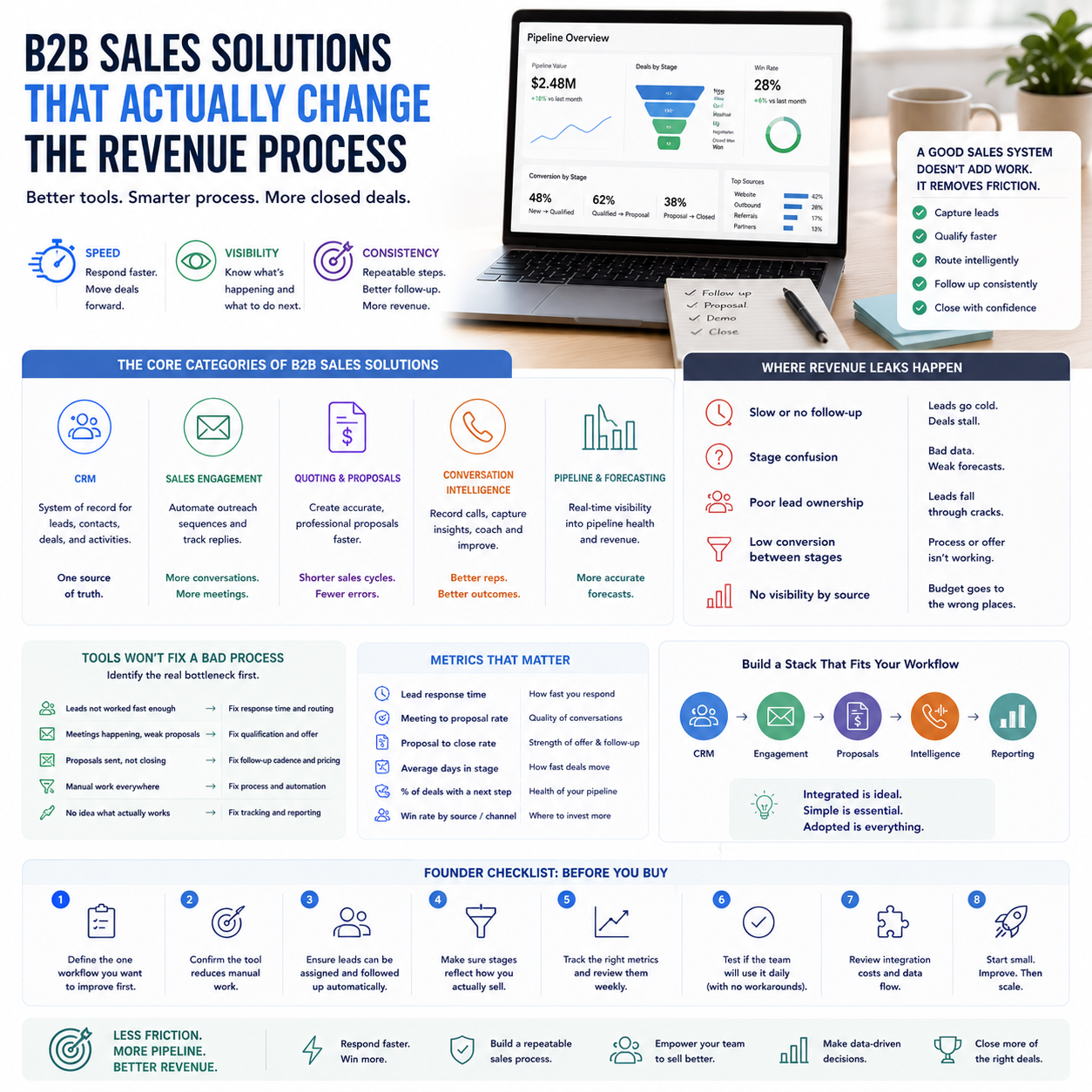
Most B2B sales advice stops at broad strategy. For operators, the real question is simpler: which parts of the sales process are weak, what should be automated, and where does the revenue leak happen? The strongest sales systems are not the loudest ones — they are the ones that improve speed, visibility, and follow-up without adding unnecessary complexity.
What a useful B2B sales solution actually does
A sales solution should solve a workflow problem, not just add another tool. For a small business, that usually means making it easier to capture leads, qualify them, route them, follow up, and close them without relying on memory or manual spreadsheets.
That is why the best solution is often a stack rather than a single platform. One tool may handle CRM records, another may manage outbound sequences, and another may give management a clearer view of pipeline health. The point is not software accumulation. The point is removing friction from the revenue process.
If your team is still updating opportunities by hand, moving contacts between systems, or guessing which deals are stalled, the issue is operational. Sales systems should create a consistent path from inquiry to proposal to close.
The most practical categories of B2B sales solutions
The candidate source on B2B sales solutions points to a broader reality: small businesses rarely need one grand overhaul. They usually need better coverage in a few specific areas.
First, CRM discipline matters. A CRM is only useful if it becomes the system of record for leads, deal stages, next actions, and owner assignments. Without that, forecasts become opinion instead of data.
Second, sales engagement tools can reduce drop-off between first contact and booked meeting. The value is not mass outreach for its own sake. It is sequence management, response tracking, and making sure no lead sits untouched after the first reply.
Third, quoting and proposal tools can shorten the close cycle. If your team sends custom quotes by copying old files or revising PDFs manually, the process is slower than it needs to be and more prone to error.
Fourth, call and meeting intelligence tools can help with consistency. For teams selling consultatively, recording objections, questions, and conversion patterns is often more useful than another round of generic sales training.
How to decide whether your business needs tools or process fixes
Many small businesses buy software when the actual issue is bad process design. Before adding a sales solution, identify where the bottleneck appears.
If leads are coming in but not being worked quickly enough, the problem is lead response time and routing. If meetings are happening but proposals are weak, the problem is qualification and offer structure. If proposals are being sent but not closed, the issue may be follow-up cadence, pricing clarity, or decision authority.
That distinction matters because software cannot fix an unclear offer or a poorly trained salesperson. It can, however, make a good process repeatable. The best purchase is the one that reduces manual work and improves handoffs between stages.
What most people miss
The hidden cost is not usually license fees. It is implementation time, process drift, and the fact that teams often stop using a tool within weeks if the workflow feels artificial. A sales solution only works if it fits the way your business already sells, or if you are ready to change the process in a disciplined way.
Where revenue leaks happen in a small sales team
The source material on B2B sales solutions is useful because it reflects common revenue leaks that small businesses can actually fix. One of the biggest leaks is inconsistent follow-up. A lead that is contacted once and never revisited is not a sales opportunity. It is a missed process.
Another leak is stage confusion. If every deal in the CRM is marked “proposal sent” but half of them are actually waiting on internal approval, your pipeline data is not actionable. That creates weak forecasting and poor prioritization.
A third leak is poor lead ownership. When sales, marketing, and operations all touch the same lead without clear responsibility, response times slow down and handoffs break.
A fourth leak is no visibility into conversion rates by source. If you cannot tell which channels create qualified meetings, you are spending money without knowing what actually produces pipeline.
What to measure before and after you buy anything
Before adopting a new sales solution, define what success should look like in operational terms. Do not measure “better sales.” Measure the part of the workflow you expect to improve.
Useful metrics include lead response time, meeting-to-proposal conversion, proposal-to-close conversion, average days in stage, and the percentage of opportunities with a next step scheduled. For outbound teams, track reply rate, booked meeting rate, and sequence completion rate.
These numbers help you decide whether the tool is improving throughput or just adding activity. If your CRM is cleaner but close rates do not move, the software may be helping administration more than revenue. If response times improve and deals move faster, the system is supporting the business.
For founders, the better decision is often to start with the one metric that matters most. If leads are expensive, focus on qualification and conversion. If sales cycles are too long, focus on follow-up and proposal turnaround. If the team is small, focus on a stack that the existing staff can actually maintain.
How to build a sales stack without overspending
Small businesses usually do not need enterprise-level complexity. They need a stack that is affordable, easy to adopt, and connected enough to avoid duplicate work.
A practical setup often includes a CRM, an email or outreach sequence tool, a proposal tool, and a reporting layer. If those systems do not integrate well, the hidden cost is manual copying between platforms. That is where smaller teams lose time.
Buy for the workflow you have now, but leave room for the workflow you want next quarter. If you expect more lead volume, look for automation and routing. If you expect longer deal cycles, look for task tracking and stage-based follow-up. If your deals are high-touch, look for call notes, reminders, and approval steps.
- Check whether the tool reduces manual data entry.
- Confirm that leads can be assigned and followed up automatically.
- Make sure pipeline stages reflect how your business actually sells.
- Track response time, conversion by stage, and average days in stage.
- Test whether the team will use it daily without workarounds.
- Review integration cost before committing to multiple platforms.
- Start with one workflow improvement, not a full system rebuild.