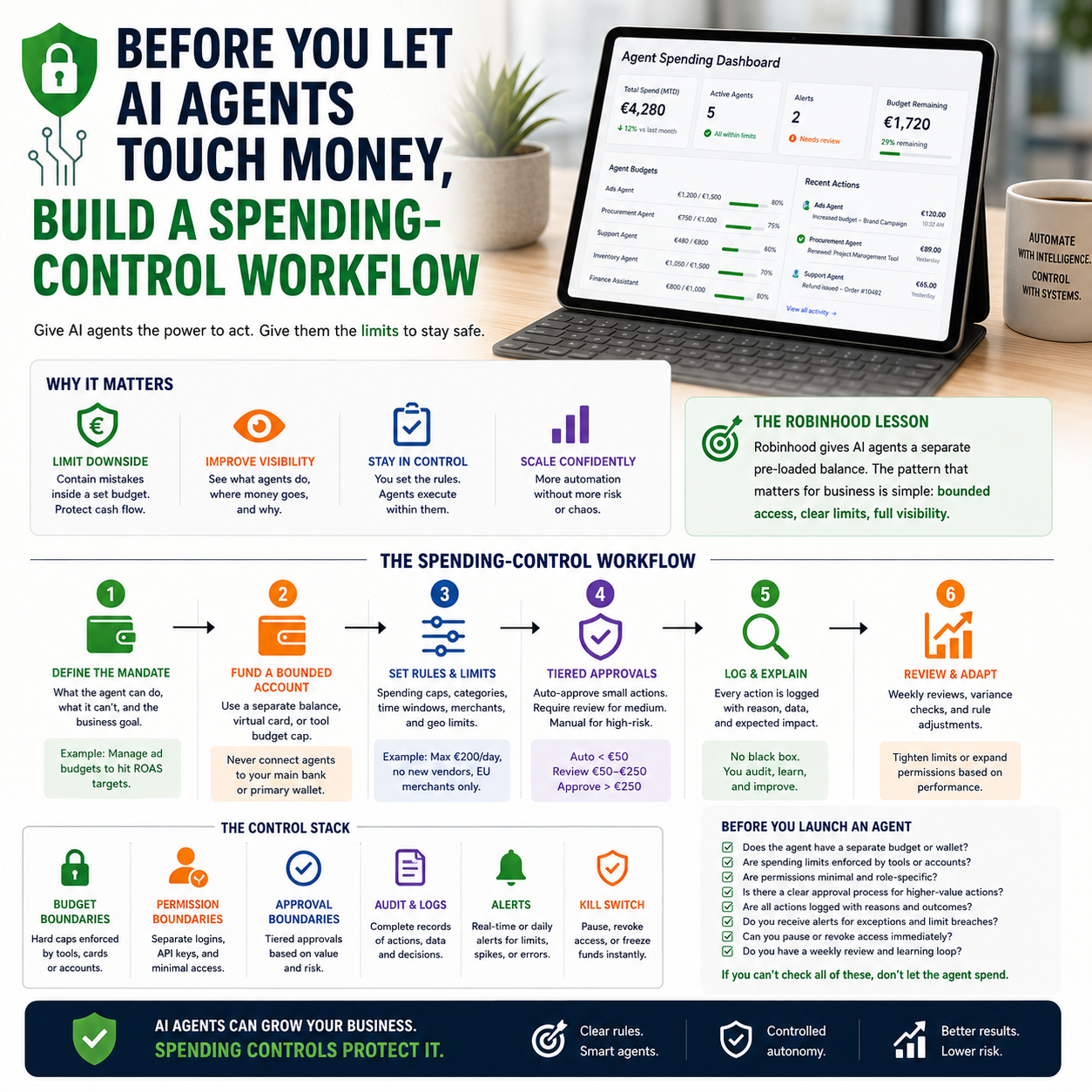
Robinhood is moving into a new operating model: users can create a separate account with a pre-loaded balance that an AI agent can use to trade stocks. For small business operators, the important part is not stock trading. It is the design pattern: an AI system gets delegated authority over real money, but only inside a bounded account.
That same pattern will appear in ad buying, supplier purchasing, software subscriptions, inventory replenishment, invoice chasing and treasury workflows. The question is not whether AI agents can act. The question is what financial perimeter a small company should build before allowing them to act.
The real lesson is the separate balance, not the trading
The Robinhood example matters because it separates the AI agent from the user’s full account. The agent does not simply receive unlimited access to all funds. It operates inside a pre-funded space. That design is much more useful for business owners than the headline about AI stock trading.
Small businesses already delegate money decisions to software, often without calling it an agent. Meta ads can spend daily budgets automatically. Google campaigns can adjust bids. Amazon sellers can enable automated repricing. Shopify apps can reorder stock. Subscription tools can renew themselves. Payment platforms can trigger refunds. The difference with AI agents is that they may combine judgment, action and tool access across several systems.
A founder who gives an agent access to email, spreadsheets, accounting software and payment tools is not just automating a task. They are creating a financial actor inside the business. That actor may be useful, but it needs the same constraints you would place on a junior operations hire: spending caps, approval rules, audit trails and clear limits on what it is allowed to decide alone.
The practical move is to copy the bounded-balance idea. Do not connect an agent directly to the main bank account, full ad account, unrestricted payment wallet or primary admin login. Create controlled operating zones where the agent can act without threatening the whole business.
Where small companies are most likely to give agents financial authority first
Most small businesses will not begin by letting AI manage investments. They will begin with lower-friction workflows where the agent saves time and the downside feels manageable. Those are exactly the places where limits need to be designed early.
The first likely use case is paid advertising. A small e-commerce seller may ask an AI agent to pause weak campaigns, test new creative, shift spend between products and update budgets based on stock levels. That sounds operationally useful. It also creates risk if the agent misreads a promotion, overreacts to a short data window or spends behind a product with poor margin.
The second is procurement. A service business may let an agent renew software, compare SaaS plans, buy credits for AI tools or place routine orders for supplies. The risk is not one dramatic loss. It is cost creep: small purchases, annual renewals and overlapping tools that quietly reduce margin.
The third is customer operations. An agent might issue refunds, offer discounts, approve replacements or apply account credits. This can reduce support workload, but it also affects gross margin and customer behavior. If the agent becomes too generous, the business may train customers to ask for concessions.
The fourth is cash collection. An agent could send payment reminders, reconcile invoices and trigger follow-ups. This is safer than spending money, but it still touches commercial relationships. A poorly timed or badly worded sequence can damage a high-value client relationship.
The control stack: budget, permission, approval, evidence
A workable AI money workflow does not start with the model. It starts with the controls around the model. Small teams do not need enterprise governance documents, but they do need a simple operating stack that prevents one bad instruction from turning into a financial problem.
Budget boundaries
Every agent that can spend, discount, refund or commit money should have a hard budget. That budget should be separate from the total business balance. In advertising, this could mean a daily or weekly test budget that cannot exceed a fixed amount. In procurement, it could mean a prepaid virtual card with a monthly cap. In customer support, it could mean a refund authority limit per order and per customer.
The important detail is that the cap should be enforced by the tool or payment layer, not just written in an instruction prompt. A prompt that says “do not spend more than €200” is not a financial control. A virtual card limit, ad account budget cap or wallet balance is a control.
Permission boundaries
Agents should not share the owner account. Create separate users, API keys, payment cards and tool roles. If the software supports read-only access, start there. If write access is required, keep it narrow. For example, an inventory agent may need permission to create draft purchase orders but not to approve payment. A support agent may need permission to draft a refund but not process refunds above a defined value.
In small teams, admin access is often treated casually because everyone is moving quickly. AI agents make that habit more dangerous. If an agent uses the founder’s login, its activity becomes harder to trace and harder to shut down selectively.
Approval boundaries
Not every action needs human approval. If everything requires approval, the workflow becomes a slower version of manual work. The practical approach is tiered approval. Low-value, reversible actions can run automatically. Medium-value actions can be batched for daily review. High-value or irreversible actions should require a human before execution.
For an e-commerce business, an agent might be allowed to pause ads automatically, create new campaign drafts for review, issue refunds under a small threshold and flag suspicious refund patterns for a manager. It should not be able to launch a major campaign, change product pricing across the store or approve bulk refunds without review.
Evidence boundaries
Every financial action should leave a reason that a human can inspect. Not a vague explanation, but the operating evidence: which metric moved, what rule was triggered, what tool was used, what amount was affected and what happened next. This is where many AI workflows fail. They produce actions but not usable records.
If an agent pauses a campaign, the log should show campaign name, spend, conversion data, inventory status if relevant and the rule that triggered the pause. If it approves a refund, the log should show order value, customer history, reason code and refund amount. Without this evidence, the owner cannot tell whether the automation is saving money or silently creating a new cost center.
What most people miss
The biggest risk is not that an AI agent makes one strange decision. The bigger risk is that it makes many small acceptable-looking decisions that shift the economics of the business.
A support agent that issues slightly more refunds may look customer-friendly for weeks before the margin effect is visible. An ad agent that keeps testing new audiences may generate activity while raising acquisition cost. A procurement agent that renews tools automatically may save administrative time while increasing software spend. A pricing agent may protect conversion rate while weakening contribution margin.
This is why agent performance cannot be judged only by task completion. A business owner needs to monitor the economic result of the workflow. Did refund rate change? Did ad spend rise faster than gross profit? Did subscription expenses increase? Did inventory turns improve or worsen? Did the agent reduce human workload enough to justify the tool cost and monitoring time?
There is also a behavioral issue. TechCrunch reported comments from Box CEO Aaron Levie about chief executives becoming unusually prone to over-belief in AI productivity gains. Whether or not that phrase is overstated, the operator lesson is practical: founders under pressure may over-delegate because they want the promised efficiency to be true. That is how a small company ends up giving automation more authority than its systems can safely support.
A practical scenario: the e-commerce ad-and-stock agent
Consider a small Shopify operator selling products with uneven stock levels and different margins. The owner wants an AI agent to reduce wasted ad spend by checking campaign performance against inventory and gross margin.
A risky setup would connect the agent to the ad account, Shopify admin, analytics and payment card, then instruct it to “optimize campaigns for profit.” That instruction sounds sensible but leaves too much undefined. Profit depends on product margin, return rate, shipping cost, discounting, stock availability and attribution quality. The agent may optimize toward the easiest visible metric instead of the actual cash result.
A safer workflow would split the process into four parts. First, the agent receives read access to Shopify product data, inventory levels and campaign performance. Second, it is allowed to pause campaigns only when a product is out of stock or below a defined stock threshold. Third, it can draft budget changes for human review when return on ad spend falls below a pre-set level for a specific period. Fourth, it writes every action to a log in Airtable, Google Sheets or the company’s operations dashboard.
The owner then reviews a daily exception list, not every campaign. The agent handles obvious mismatches, such as ads sending traffic to unavailable stock. The human handles margin tradeoffs, seasonal context and creative judgment. This keeps automation close to the workflow but away from decisions that require broader commercial context.
The cost side is also visible. The business may pay for the AI tool, integration platform, analytics connector and a few hours of setup time. Those costs need to be compared with avoided wasted ad spend, fewer manual checks and faster response to stock problems. If the workflow saves time but causes the owner to buy three extra tools and spend hours auditing logs, it may not be worth scaling.
The metrics that decide whether the agent deserves more authority
Small teams should not expand agent permissions because the demo looked impressive. They should expand authority only when the workflow proves itself against business metrics.
For an ad-related agent, track spend controlled by the agent, number of automatic pauses, number of human overrides, gross margin by promoted product, wasted spend on out-of-stock items and cost per order after refunds. If the agent reduces obvious waste but increases unnecessary campaign churn, the rules need tightening.
For a procurement agent, track monthly software spend, duplicate subscriptions, renewal approvals, purchases by category and unused licences. If automation speeds up buying but weakens cost discipline, it is not an operations win.
For a refund or customer support agent, track refund rate, average refund value, repeat refund requests, customer lifetime value where available and manager reversals. A higher refund rate is not automatically wrong if it prevents chargebacks or protects valuable customers, but the tradeoff has to be visible.
For an invoice collection agent, track days sales outstanding, response rate, disputes created, escalations and payments recovered. The agent should improve collection discipline without creating unnecessary friction with good customers.
The most important metric across all workflows is override rate. If humans regularly reverse the agent’s decisions, the agent is not ready for wider authority. If the override rate is low and the financial result is improving, the business can consider raising limits gradually.
Tool design choices that matter before the first live transaction
Before connecting an AI agent to financial tools, decide whether the workflow needs direct execution or draft-only mode. Draft-only mode is often enough at the start. The agent prepares campaign changes, refund recommendations, purchase orders or invoice messages, but a human approves them.
Next, decide where the financial boundary will live. Good options include prepaid balances, virtual cards, separate ad budgets, limited wallet balances, user roles and API scopes. Weak options include written instructions, shared passwords and trust that the agent will ask before acting.
Then decide how the log will work. A useful log should include timestamp, action, amount, account or campaign affected, data source, rule triggered and approval status. If the log is too vague, it will not help during a dispute or audit. If it is too detailed and unreadable, nobody will review it. For many small teams, a structured table is better than a long narrative report.
Finally, decide who owns the workflow. AI money workflows often fail because responsibility is split between the founder, a freelancer, a marketing assistant and a tool vendor. One person needs to own budget limits, access rights, performance review and shutdown procedures.
When not to automate the money decision
Some decisions should stay human-led even if the agent can technically perform them. Do not automate decisions where the data is incomplete, the customer relationship is sensitive, the cost of error is high or the action is hard to reverse.
Examples include changing prices across a whole store, approving large refunds, moving cash between accounts, cancelling supplier contracts, launching large paid campaigns, committing to annual SaaS plans or making investment decisions with business reserves. An agent can prepare analysis for these decisions, but execution should stay with a person who understands the wider context.
There is also a timing issue. A business with messy product margins, inconsistent campaign naming, weak bookkeeping or unclear refund rules is not ready for autonomous money workflows. The agent will inherit the mess. Automation works better after the operator has defined categories, thresholds and responsibilities.
Rollout sequence for a small team giving agents limited money access
Use this sequence before allowing any AI agent to spend, refund, discount or commit funds:
- Map the exact financial action: Define whether the agent will spend ad budget, issue refunds, buy tools, draft invoices, send reminders or create purchase orders.
- Start with read-only access: Let the agent analyse data and make recommendations before it can execute anything.
- Create a separate operating zone: Use a prepaid balance, virtual card, separate ad budget, limited user role or restricted API key.
- Set hard caps outside the prompt: Enforce limits in payment, platform or account settings, not only in AI instructions.
- Use draft mode for medium-risk actions: Require approval for budget changes, refunds above threshold, supplier purchases and customer credits.
- Log every action in one place: Capture action, amount, reason, data source, approval status and human override.
- Review weekly economics: Compare the workflow against margin, spend, refund rate, collection speed, tool cost and time saved.
- Raise authority slowly: Increase limits only when override rates are low and the financial result is improving.
- Keep a shutdown path: Know which API key, card, user role or account setting can stop the agent immediately.
The operator advantage is not in letting AI act everywhere. It is in designing small, bounded workflows where the agent can remove low-value manual work without gaining unchecked control over the company’s money.