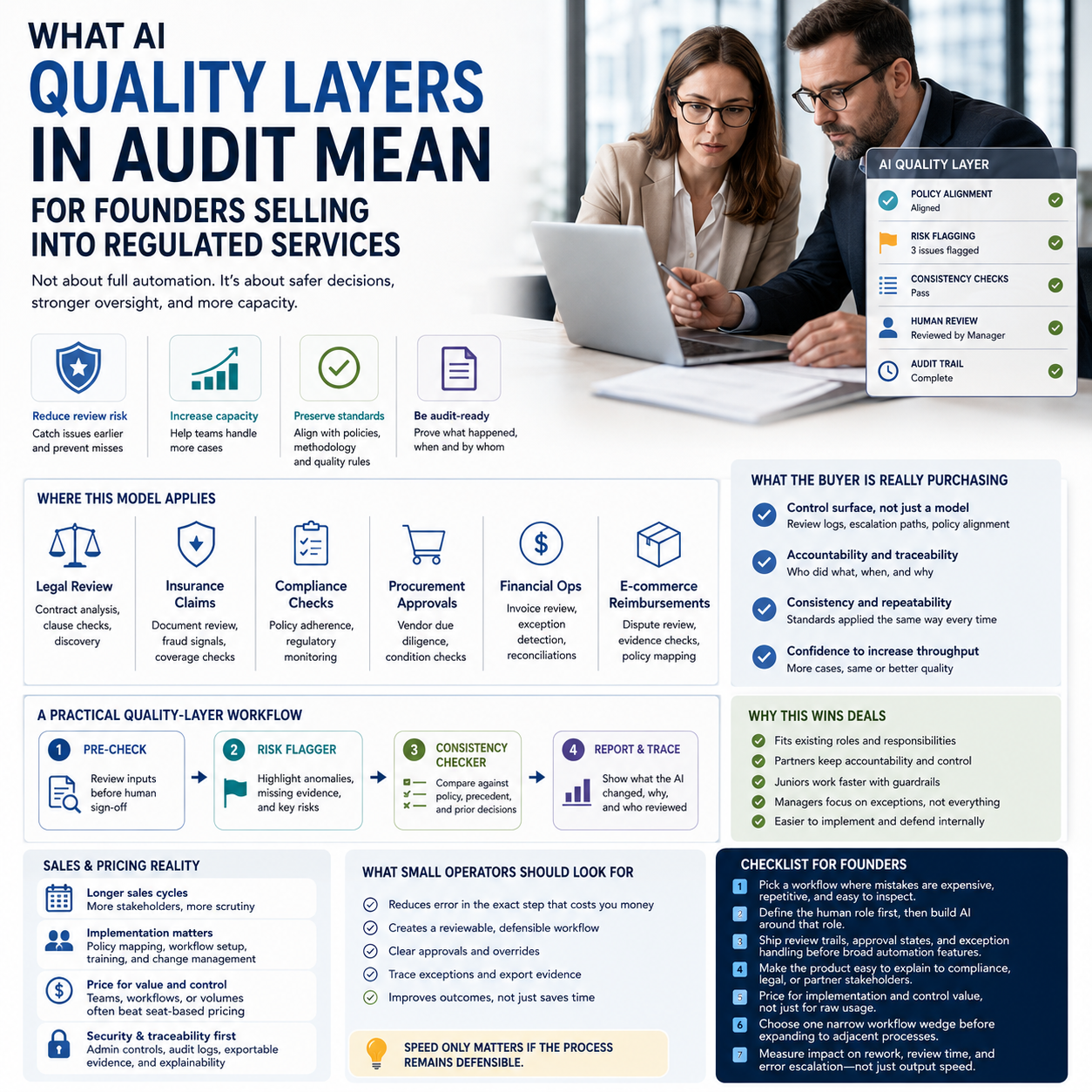
Audit firms are not buying generic AI assistants. They are buying systems that reduce review risk, preserve professional standards, and fit into workflows where a mistake can create expensive downstream damage. That makes Cortea’s new AI quality layer more than another funding announcement: it is a signal about how AI products can be sold into regulated services.
For founders, the practical question is not whether “AI for professionals” is hot. It is whether you can build a product that becomes part of a firm’s control stack, not just a nice-to-have productivity add-on.
Why the audit use case matters beyond accounting
Cortea’s pitch is simple to translate into other verticals: use AI to improve quality while increasing capacity in a workflow where human judgment still matters. That model is relevant anywhere operators need speed without losing oversight.
Think legal review, insurance claims, compliance checks, procurement approvals, financial operations, or e-commerce reimbursement review. In all of these, the buyer is not asking for full automation. They want a layer that flags risk, structures work, and helps staff get through more cases with fewer misses.
This is a useful signal for founders because it changes the product brief. You are not building “AI that does the work.” You are building “AI that makes the work safer, more consistent, and easier to audit.” That is a very different sales motion, implementation path, and pricing model.
What the buyer is actually purchasing
In regulated services, the real product is usually not the model itself. It is the control surface around the model: review logs, escalation paths, policy alignment, and output consistency. If your software cannot show where it helped, what it flagged, and when a human had to intervene, it will struggle in serious buying cycles.
This is why an “AI quality layer” is commercially interesting. It answers a budget owner’s concern: can we increase throughput without lowering quality? That is easier to justify than a broad promise of automation.
What most people miss
Many founders think the main objection in regulated markets is trust in AI. Often the deeper objection is accountability. Buyers do not only want accuracy; they want to know who owns the decision when the system is wrong. Products that surface this clearly can move much faster than products that only optimize output speed.
For an operator, that means the strongest features are often not the flashiest. Versioning, review trails, exception handling, approval gates, and role-based access may matter more than a stronger model benchmark. In these markets, procurement teams and partners buy governance as much as they buy intelligence.
How to package the product so it can pass internal review
Founders entering this space should think in terms of workflow modules, not broad AI platforms. A useful product usually starts with one narrow, high-friction step where mistakes are costly and repetition is high.
Examples of a workable package:
First, a pre-check layer that reviews documents before a human signs off. Second, a risk flagger that highlights anomalies and missing evidence. Third, a consistency checker that compares output against internal policy or prior decisions. Fourth, a reporting layer that shows what the AI changed and why.
This structure makes implementation easier because it maps to existing roles. Partners can keep accountability. Juniors can move faster. Managers can inspect exceptions rather than read every line manually. That is the kind of operational design that turns AI into infrastructure instead of a pilot project.
Pricing, sales, and implementation: what founders should expect
Selling into audit-like environments usually means longer sales cycles and higher implementation effort than SMB software. That should influence both pricing and fundraising assumptions. If your product requires policy mapping, onboarding, and review workflow setup, you need pricing that reflects that service burden.
A seat-based SaaS model may still work, but many buyers will respond better to pricing tied to teams, workflows, or controlled volumes. A flat low-cost product can be a bad signal in regulated markets because it may look disposable rather than mission-critical.
Founders should also expect product requirements to be driven by security, permissions, and traceability. If those are bolted on later, the deal can stall. In practice, the product roadmap needs to include admin controls, audit logs, exportable evidence, and the ability to explain how outputs were generated or modified.
What this means for small operators buying AI tools
For smaller firms, the lesson is not to mimic enterprise complexity. It is to buy tools that reduce error in the exact step that costs you money. If a tool saves time but increases rework, it is not a control improvement; it is a hidden expense.
Small operators should ask whether the AI tool creates a reviewable workflow. Can you see who approved what? Can you override outputs cleanly? Can you trace exceptions? Can you export the evidence if a client or regulator asks?
That matters even outside audit. In e-commerce, for example, the equivalent might be an AI layer for dispute handling or catalog compliance. In finance operations, it might be invoice review or payment exception routing. The buying logic is the same: speed only matters if the process remains defensible.
Checklist for founders evaluating an AI quality-layer opportunity
- Pick a workflow where mistakes are expensive, repetitive, and easy to inspect.
- Define the human role first, then build AI around that role.
- Ship review trails, approval states, and exception handling before broad automation features.
- Make the product easy to explain to compliance, legal, or partner stakeholders.
- Price for implementation and control value, not just for raw usage.
- Choose one narrow workflow wedge before expanding to adjacent processes.
- Measure whether the product reduces rework, review time, or error escalation, not only whether it generates output faster.