Elastic’s reported agreement to buy DeductiveAI for up to $85 million is more than a startup exit story. It is a signal that AI bug detection is moving from a nice-to-have feature into a product category with a clear business case: reduce engineering time spent on incidents, triage, and repetitive fixes.
For founders and operators, the important question is not whether “AI for software” is exciting. The question is which part of the software delivery stack is now worth paying for, and how to judge whether a tool like this saves real money or just adds another dashboard.
Why this deal matters to operators
DeductiveAI is described as a startup that uses AI to catch and resolve bugs in software. That framing matters because the buyer is not just purchasing a model or a feature. It is buying a workflow that sits close to engineering operations, observability, and incident response.
For small software teams, the value proposition is easy to understand. A single unresolved bug can absorb senior engineer time, interrupt release schedules, and create support load. If an AI system can shorten the path from detection to root cause to fix, the financial upside comes from fewer engineering hours wasted, fewer customer-facing incidents, and less pressure on on-call teams.
The reported Elastic move also suggests that observability vendors are looking for differentiated AI layers rather than broad “AI assistant” branding. That matters for buyers because these tools are increasingly bundled into platforms you may already use, rather than sold as standalone experiments.
Where the real ROI comes from
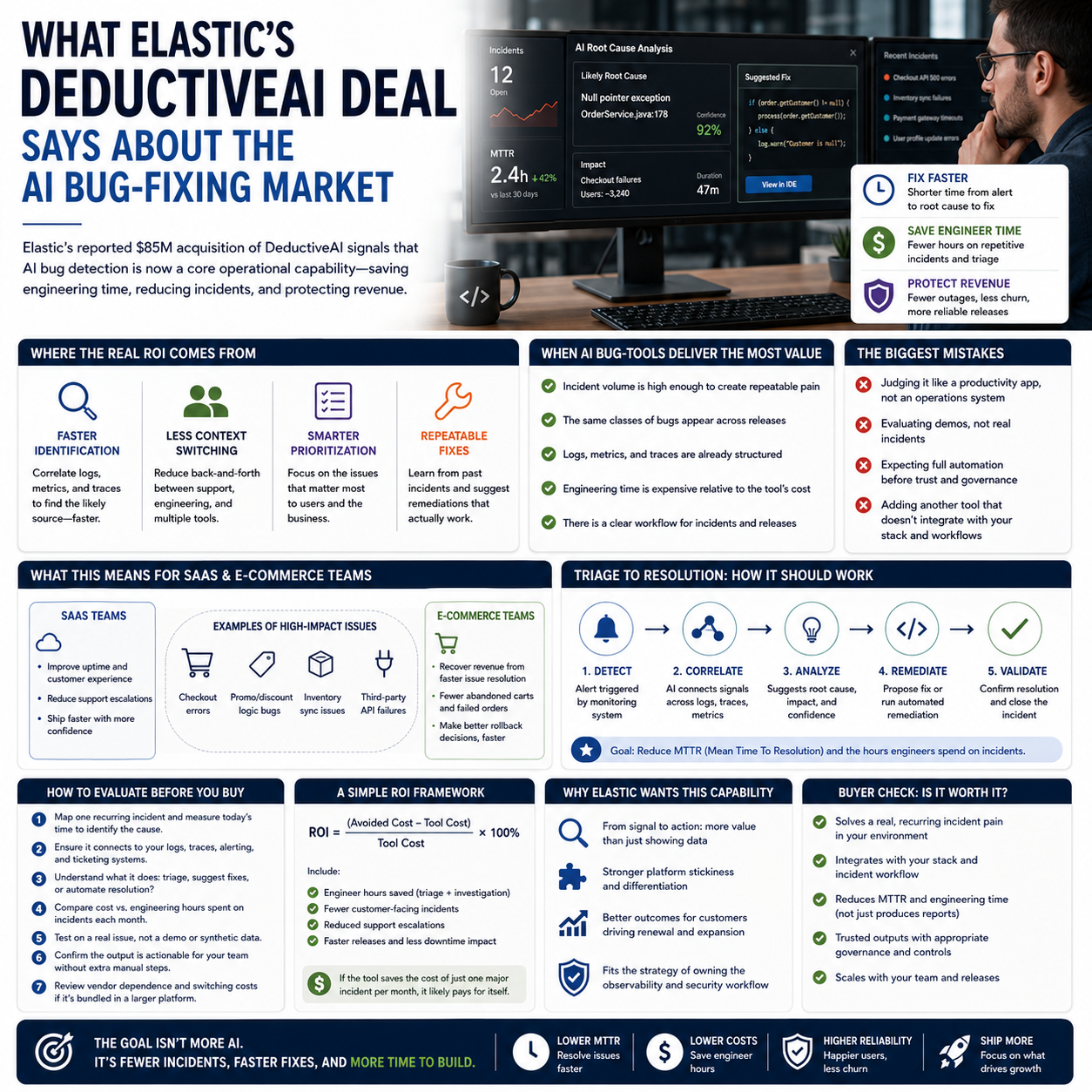
Most teams overestimate the value of AI bug tools when they focus on code generation and underestimate it when they ignore incident handling. The strongest ROI usually comes from the boring parts: identifying the likely source of a problem faster, correlating logs and traces, and reducing the back-and-forth between support and engineering.
If you run a product business, the best way to think about this is through operational cost, not software novelty. Every hour a senior engineer spends searching for the cause of a recurring issue is an hour not spent shipping revenue work. Every support ticket that requires engineering intervention adds hidden labor cost. Every release delay can push back sales commitments or customer onboarding.
That makes these tools most attractive in teams where:
– incident volume is high enough to create repeatable pain
– the same classes of bugs appear across releases
– logs, metrics, and traces are already structured enough for a system to use
– engineering time is expensive relative to the cost of the tool
What most people miss
The biggest mistake is evaluating AI bug-fixing software like a productivity app. It should be judged like an operations system. If it cannot connect to your monitoring stack, your ticketing flow, and your release process, it may be clever but still unusable.
Another missed point is governance. A tool that suggests fixes is not automatically safe to let act on production issues. For many teams, the right purchase is not full automation but assisted triage: faster detection, better prioritization, and clearer handoff to engineers.
What this means for SaaS and e-commerce teams
Even if you are not building developer tools, this trend affects you. SaaS and e-commerce businesses depend on uptime, checkout reliability, and quick resolution of customer-facing errors. If your team uses platforms with built-in AI observability or automated bug detection, you may be able to tighten incident response without hiring more engineers.
For e-commerce operators, the operational relevance is especially direct. A checkout bug, broken promotion rule, inventory sync error, or API failure can leak revenue immediately. In that setting, the value of AI-assisted debugging is measured in recovered orders, fewer support escalations, and faster rollback decisions.
Founders should also watch the vendor strategy here. When larger infrastructure companies acquire startups like DeductiveAI, the capability often gets embedded into broader product suites. That can be good for procurement because it reduces tool sprawl. But it can also create lock-in if your incident workflows become tightly tied to one platform.
How to evaluate these tools before buying
Do not start with feature checklists. Start with one recent incident and ask whether the tool would have changed the outcome. Would it have identified the issue faster? Would it have pointed to the likely subsystem? Would it have reduced the number of people pulled into the investigation?
Then test the economics. If the monthly cost is lower than the labor cost of one avoided incident review, the case is strong. If the tool mainly produces summaries without changing resolution time, it is probably a reporting layer, not an operations layer.
It is also worth checking whether the product fits the maturity of your team. Early-stage companies often need simpler alert reduction and clearer prioritization. More mature teams may benefit from automated root-cause analysis and structured remediation suggestions. Buying the wrong level of sophistication creates another operational burden instead of removing one.
Why Elastic may want this capability
Elastic already sits in the world of search, observability, and security workflows. Adding a bug-catching startup fits a broader pattern in enterprise software: vendors want to own the path from signal to action. If the platform can detect a problem and help resolve it, it becomes more valuable than a system that only reports what went wrong.
That matters because buyers increasingly prefer fewer tools that connect well over many tools that each solve one narrow problem. For vendor selection, this means the winning product is often the one that can be operationalized inside the stack you already run, not the one with the most impressive demo.
For startups selling into this space, the deal also shows the exit logic. If your AI product improves a core operational workflow and can be absorbed into a broader platform, that may be a more realistic route than trying to become a standalone category leader.
Decision criteria for founders and operators
- Map one recurring incident type and measure how long it takes to identify the cause today.
- Check whether the tool connects to your logs, traces, alerting, and ticketing systems without custom engineering.
- Ask whether it speeds up triage, suggests fixes, or actually automates resolution, and choose based on your risk tolerance.
- Compare the tool’s cost with the engineering hours spent on incidents in a normal month.
- Test it on a real issue, not a sample dataset or demo environment.
- Confirm whether the output is usable by your team without adding another manual review layer.
- Review vendor dependence: if the capability is bundled into a broader platform, understand what switching costs you may create.