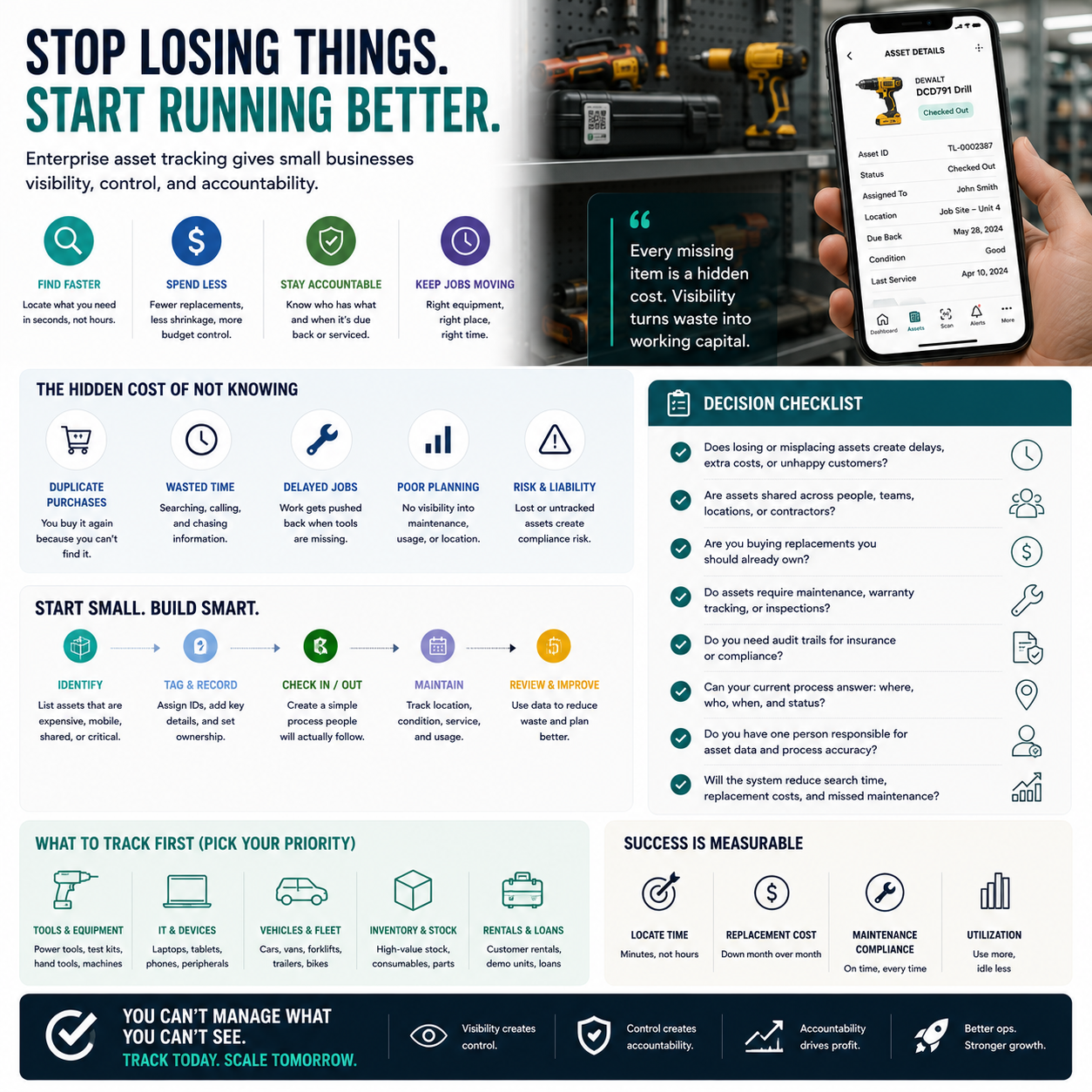
Most small businesses do not lose money because they lack effort; they lose money because they lose track of things. Tools disappear, equipment gets duplicated, service jobs run late, and no one can answer a basic question quickly: what do we own, where is it, and who has it?
That is why enterprise asset tracking matters even for smaller operators. The real decision is not whether to buy software, but whether your business has reached the point where asset visibility affects jobs, cash flow, and accountability.
What enterprise asset tracking actually solves
Asset tracking is not just a database of equipment. In practice, it is a system for knowing the location, status, ownership, and movement history of valuable items across your business. That can include laptops, tools, rental equipment, POS devices, vehicles, demo units, or inventory that gets moved between sites.
For founders and operators, the value comes from reducing confusion. If a device is assigned to an employee, a tool is checked out for a project, or equipment is sitting idle at another location, the tracking record should make that visible without a manual search.
The practical benefit is operational control. When you can answer asset questions quickly, you reduce replacement purchases, speed up audits, and avoid delays caused by missing equipment.
What most people miss
The mistake many businesses make is treating asset tracking as a technology purchase instead of a process decision. If your team does not agree on how items are tagged, checked out, returned, and retired, the software will just store messy data faster.
Another common miss is tracking too much. Businesses often start with every possible item, then abandon the system because the process becomes too heavy. A better starting point is to track the assets that are expensive, mobile, frequently shared, or critical to service delivery.
When the business case becomes obvious
You do not need a large fleet or warehouse to justify asset tracking. The trigger is usually operational friction. If your team regularly asks any of these questions, the business may already be paying a hidden cost:
Where is the equipment right now? Who last used it? Is it under warranty? Which location owns it? What needs repair before the next job?
These questions matter because each unanswered one creates work. Someone has to search, call, guess, reorder, or delay. That means labor time spent on recovery instead of revenue-producing work.
Asset tracking also becomes useful when a business is growing across multiple locations or adding contractors. The more handoffs that happen, the easier it is for assets to drift out of control. A founder may not notice the problem until replacement spending rises or a client-facing job is delayed because a key item cannot be found.
Choosing between simple tracking and a fuller system
Not every company needs a complex platform. Some businesses only need barcode labels, a shared register, and a disciplined check-in and check-out routine. Others need mobile scanning, role-based permissions, maintenance logs, and integrations with purchasing or ERP tools.
The decision depends on the scale of movement, the value of the items, and the number of people touching them. If assets move between only a few people and locations, a light system may be enough. If equipment cycles through field teams, branches, or customer sites, a more structured platform reduces the chance of gaps.
Technology choice should follow workflow, not the other way around. A tool that is too advanced for the team will be abandoned. A tool that is too basic for the complexity of the business will create blind spots.
How to measure whether it is working
Tracking only matters if it changes behavior. The useful metrics are operational, not abstract. Look at how long it takes to locate a critical asset, how often items are replaced because they cannot be found, how many assets are overdue for maintenance, and how much time staff spend on manual searching.
Finance teams should also watch replacement spending and shrinkage. If a company is buying the same category of equipment repeatedly, the issue may not be demand. It may be leakage, poor assignment control, or weak retirement rules.
Operations teams should track compliance with the process. If items are not being checked in properly, the system will become unreliable. In that case, the fix is usually better process design, clearer ownership, or a simpler workflow.
What to implement first
Start with the assets that create the highest cost when they go missing or disappear from view. That usually means equipment used across teams, items with maintenance requirements, or anything needed to deliver client work on schedule.
Then define a small set of fields that matter: asset ID, owner or location, status, purchase date, last maintenance date, and assigned user. If the record is easy to maintain, the team is more likely to keep it updated.
Finally, make one person accountable for the process, even if several teams use it. Asset tracking fails when everyone can update it but no one owns data quality.
Decision criteria for small business operators
- Track assets if losing or misplacing them causes job delays, replacement purchases, or service failures.
- Start simple if only a small team handles the items and movement is limited.
- Choose stronger software if items move across locations, teams, or contractors on a regular basis.
- Prioritize assets that are expensive, critical, shared, or maintenance-heavy.
- Require a check-in and check-out process before expanding the system.
- Assign one owner for data accuracy and process compliance.
- Review whether the system is reducing search time, replacement costs, and maintenance misses every month.


