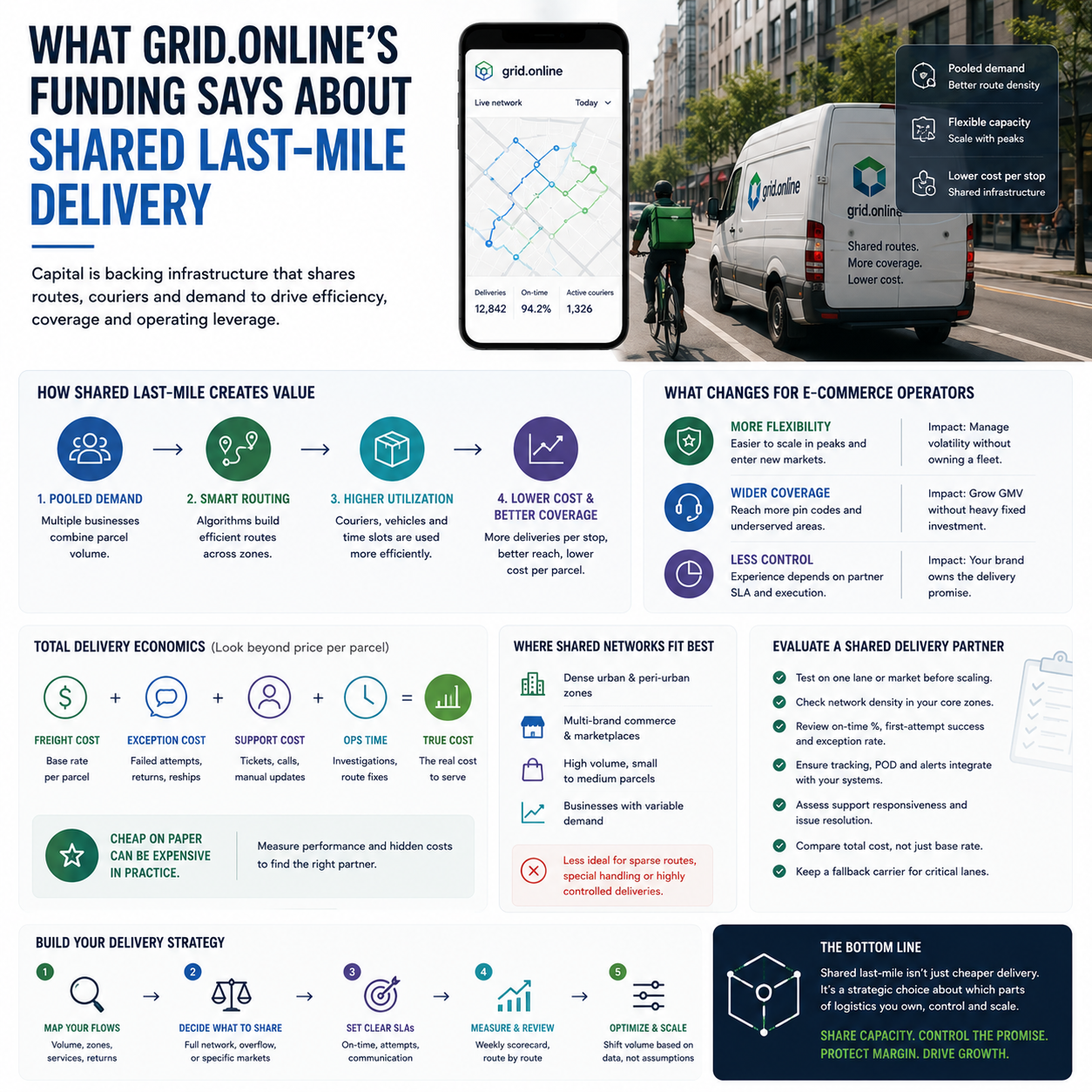
Shared delivery networks are no longer just a logistics experiment. Grid.online’s new funding round is a useful signal for any founder or operator who depends on parcel delivery: the real question is not whether delivery can be outsourced, but which parts of the network you want to own, control or share.
The model matters because it changes who carries the fixed cost, who absorbs volatility, and where service quality is won or lost. For e-commerce brands, marketplaces and local operators, this is less about “faster shipping” and more about margin, coverage and operating leverage.
Why shared last-mile delivery is attracting capital
Grid.online is building shared infrastructure for first- and last-mile parcel delivery, and its fundraising indicates investor interest in a simple operational idea: if enough couriers, routes and parcel flows can be pooled, a network can become more efficient than a single operator trying to cover everything alone. That is attractive in fragmented markets where delivery demand is uneven and peak periods create expensive overcapacity.
For a small business, the implication is practical. A delivery partner built on shared infrastructure may offer better reach into under-served areas, more flexible capacity during peaks, or lower cost per stop than a fully owned fleet. But that only holds if the network actually has density where your parcels move. Without density, shared infrastructure can become shared complexity.
What changes for e-commerce operators
The key decision is whether delivery should be treated as a brand promise, a cost center, or a mixed operating layer. If you sell products with narrow delivery windows, high repeat purchase value, or high damage sensitivity, the delivery handoff affects retention as much as it affects cost. If you sell commodity items with thin margins, the main issue is protecting contribution margin when shipping costs rise.
Shared networks can help on three fronts. First, they can reduce your dependency on a single carrier’s capacity. Second, they can improve routing flexibility when you need local or regional coverage. Third, they can make it easier to test service tiers, such as same-day in one city and standard delivery elsewhere, without building a fleet from scratch.
But the trade-off is control. Once delivery is handled by a pooled network, your ability to shape the customer experience depends on service-level agreements, scan discipline, exception handling and communication workflows. If those are weak, the brand owns the complaint even when it does not own the driver.
What most people miss
The mistake is to compare shared delivery only on headline price per parcel. That misses the hidden operating costs that appear when delivery fails: support tickets, refunds, reships, manual routing fixes, and the internal time spent managing exceptions. In many businesses, those soft costs are what turn a cheap carrier into an expensive one.
The better comparison is total delivery economics. That means looking at on-time performance by lane, exception rate, failed first attempts, customer support load, and how often the logistics team has to intervene manually. A network like Grid.online becomes interesting if it can reduce those hidden costs while keeping flexible capacity available when demand spikes.
How to evaluate a shared delivery partner
Do not start with brand claims. Start with operational fit. A shared network should be tested against your actual parcel profile: package sizes, delivery density, geographic spread, return rate and service expectations. The same carrier can be excellent for one category and poor for another.
Founders should ask whether the partner can handle three things reliably: route consistency, exception resolution and visibility. If the driver network is large but the data layer is weak, you may get coverage without control. If visibility is strong but courier adoption is shallow in your core markets, you may get dashboards without actual performance.
Grid.online’s growth also points to a broader question for operators: do you want logistics capacity to be an asset you buy, or a market you tap when needed? The answer depends on parcel volume stability. Businesses with predictable flows may extract more value from negotiated dedicated capacity. Businesses with volatile demand, new-market expansion or uneven regional volume may benefit more from pooled infrastructure.
What most people miss
Shared delivery is not only a logistics choice. It is a cash-flow choice. When you avoid fixed fleet costs, you also avoid tying up capital in vehicles, dispatch systems and idle labor. That can matter more than the delivery rate itself if you are still proving demand or expanding into new regions.
Where this model fits best
Shared last-mile networks are strongest where demand is dense enough to create route efficiency but fragmented enough that no single business wants to carry the full operating burden. That usually means urban and peri-urban zones, multi-brand commerce, local retail networks and marketplace-style parcel flows. It is less compelling where parcels are sparse, highly specialized or require strict control over handling.
For founders, the strategic lesson is not to copy the model, but to decide where pooling makes sense in your own stack. You can share the delivery layer and still own the customer relationship. You can keep your warehouse in-house and outsource the route layer. Or you can use the shared network only for overflow and test markets. The point is to separate control from capacity instead of treating logistics as one bundle.
Decision checklist for operators
- Map your parcel flow by zone, volume and service level before changing carriers.
- Compare total delivery cost, including support time, reships and failed delivery handling.
- Test the network on one lane or market before migrating core volume.
- Check whether tracking, proof of delivery and exception alerts integrate with your order system.
- Measure on-time delivery, first-attempt success and manual intervention rate weekly.
- Use shared capacity for volatile demand, new regions or overflow before moving stable volume.
- Keep a fallback carrier ready if the network lacks density in your highest-value markets.


