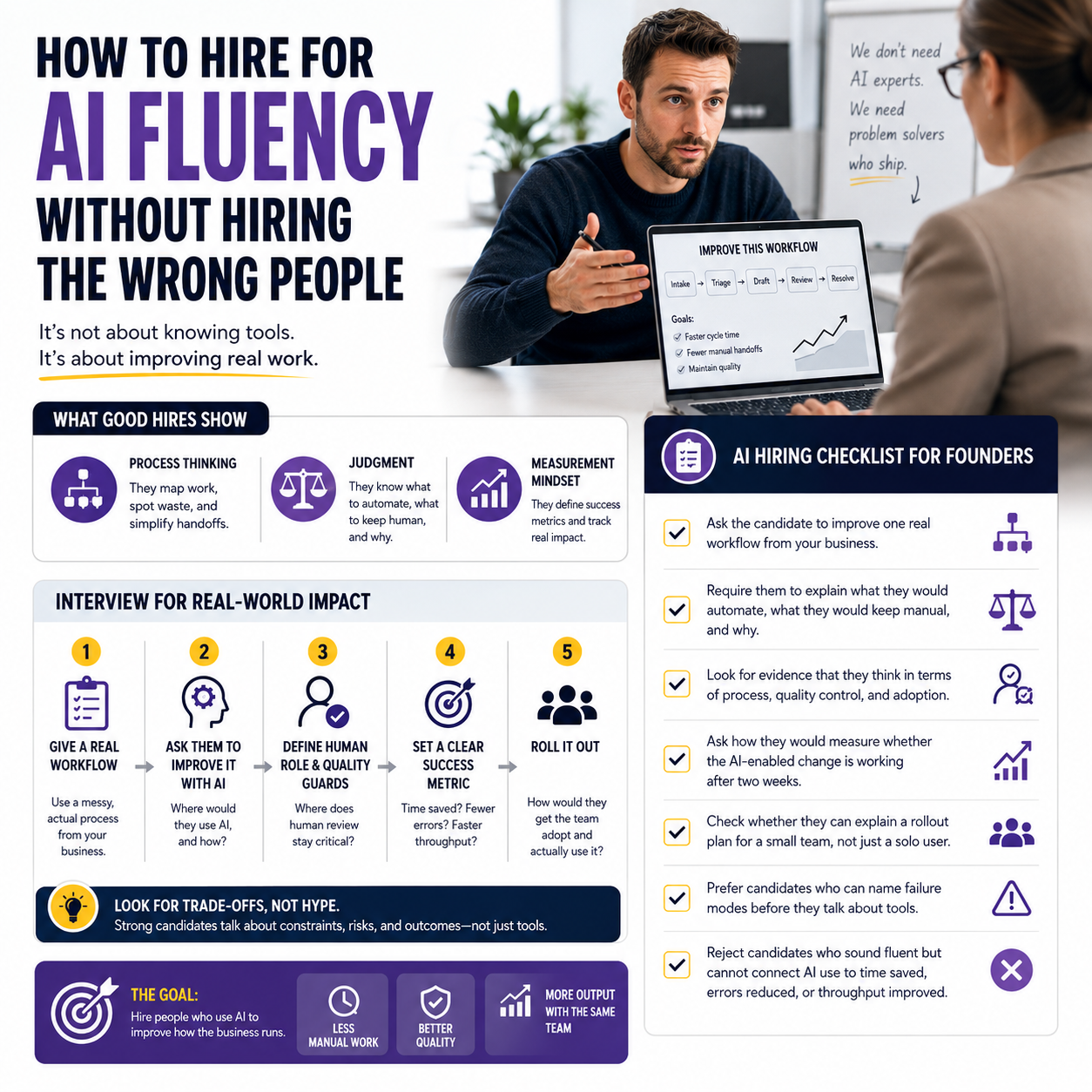
Many founders are now trying to hire for AI fluency, but the phrase is often doing too much work. A candidate can sound sharp on prompt engineering, tool choice, and automation buzzwords and still be unable to improve a real workflow on day one. The risk is not just a bad hire; it is a slow drain on momentum, time, and internal trust.
The better question is not whether someone “knows AI.” It is whether they can apply it to the actual work your business needs done, under the constraints that matter: speed, quality, cost, and team adoption.
Why AI fluency is a weak hiring label
The candidate story behind the hiring boom is familiar: companies add AI questions to interviews, update job descriptions, and ask managers to screen for tool use. But if the interview itself is abstract, candidates quickly learn to perform confidence instead of demonstrating utility. That creates a gap between the person you thought you hired and the person who arrives on the job.
For small businesses and startups, that gap is expensive. A marketer who can explain the difference between models but cannot cut campaign production time is not solving a business problem. An ops hire who can name a few tools but cannot map a workflow is not reducing friction. The label matters less than the output.
What to test instead of “AI knowledge”
Use the interview to test whether the candidate can work inside your business, not whether they can talk about AI in the abstract. The strongest candidates tend to show three things: they understand process, they can make judgment calls, and they can describe how to measure whether the change is worth keeping.
That means the interview should include a real workflow from your company. For example, a support lead might be asked to redesign ticket triage using AI-assisted tagging. A content operator might be asked to shorten brief creation without lowering editorial standards. A sales hire might be asked how they would use AI to clean up lead notes and follow-up tasks without creating more admin.
Do not ask only what tools they know. Ask what they would automate, what they would not automate, and what failure mode they would watch first. That tells you whether they understand business trade-offs or just software names.
What most people miss
AI fluency is not just a skill check. It is a change-management check. Even a capable hire can fail if they cannot help the rest of the team adopt a new workflow. The real risk is hiring someone who is individually clever but operationally disruptive.
Design interviews around workflows, not opinions
A useful interview exercise should mirror the actual work, stay short, and force the candidate to make trade-offs. Give them a messy process and ask how they would improve it using AI, where human review is still required, and what the measurable outcome should be.
For a founder, this is more valuable than asking theoretical questions about “the future of work.” You want to see whether the person can identify the manual steps that waste time, the point where quality can break, and the minimum system needed to make the workflow repeatable.
If the role touches marketing, operations, or customer support, ask for a before-and-after workflow. If the role is technical, ask how they would evaluate whether a model-assisted process is reliable enough for production. If the role is cross-functional, ask how they would roll out a change so the team actually uses it.
That last part matters. A hire who can design a cleaner workflow but cannot get it adopted will not help your business move faster. In small teams, adoption is part of the job.
Where startup momentum gets quietly damaged
The article’s warning is not that AI-competent candidates are rare. It is that many hiring processes reward performance over proof. Once a startup believes it is hiring for future readiness, it may overlook the practical questions that keep momentum intact: can this person deliver within our current stack, can they learn fast enough, and can they improve a process without creating new bottlenecks?
Momentum is usually lost in small ways. A founder spends weeks onboarding someone who needs too much direction. A team adopts a tool but never standardizes when and how it is used. A manager assumes “AI fluency” means the person will immediately spot automation opportunities, then discovers that no one defined the workflow or success metric.
The fix is to hire for applied judgment, not just curiosity. Curiosity gets attention. Judgment saves time.
How this changes the hiring decision
For founders and small business owners, the practical decision is whether you are hiring someone to use AI as a personal productivity aid or to improve a business process. Those are not the same thing. The first is about individual efficiency. The second is about operational leverage.
If you need someone to work in a repeatable system, prioritize candidates who can explain process design, adoption, and measurement. If you need someone to experiment, prioritize candidates who can show how they test tools without creating unnecessary risk. If you need someone to lead others, prioritize communication and rollout ability over flashy tool knowledge.
The salary question also changes. A candidate who can save 5 hours a week on their own tasks is useful. A candidate who can remove a recurring step from a team workflow is often far more valuable. The second hire deserves a different evaluation because they affect more than their own output.
Use this hiring checklist before you make the offer
- Ask the candidate to improve one real workflow from your business, not a hypothetical one.
- Require them to explain what they would automate, what they would keep manual, and why.
- Look for evidence that they think in terms of process, quality control, and adoption.
- Ask how they would measure whether the AI-enabled change is working after two weeks.
- Check whether they can explain a rollout plan for a small team, not just a solo user.
- Prefer candidates who can name failure modes before they talk about tools.
- Reject candidates who sound fluent but cannot connect AI use to time saved, errors reduced, or throughput improved.