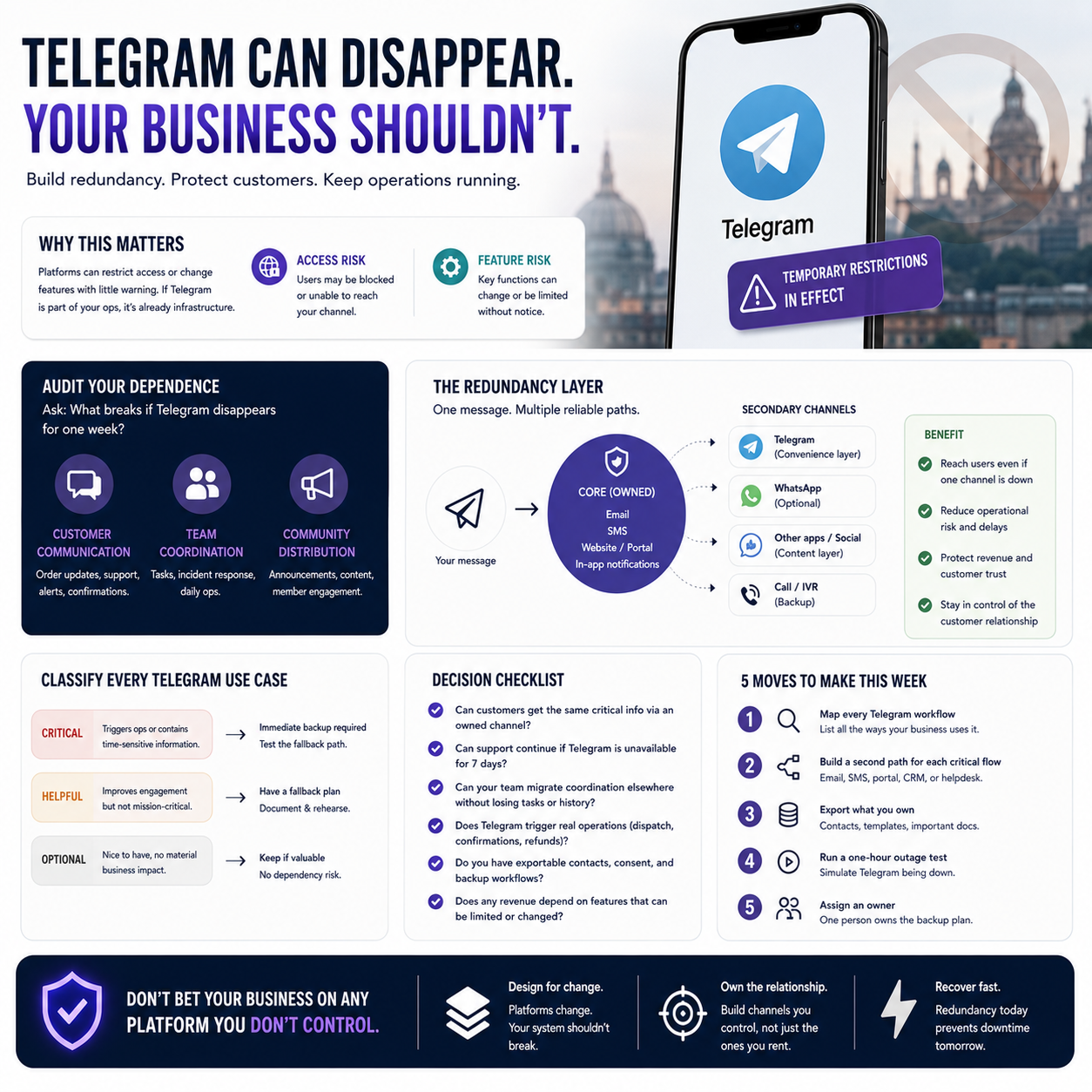
India’s temporary restrictions on Telegram are not just a consumer app story. They are a reminder that any business built on a third-party platform can lose access, distribution, or key features with little warning. For founders, e-commerce operators, and community-led brands, the real question is not whether Telegram is useful. It is how much operational dependence you can afford.
Why this matters to operators
Telegram is often used as a lightweight customer support layer, an order-update channel, a private community hub, or an internal coordination tool. When a platform becomes part of your sales or service workflow, it stops being a marketing channel and starts becoming infrastructure. That changes the risk profile immediately.
The reported restrictions in India highlight two separate risks: access risk and feature risk. Access risk means users may not be able to reach the channel at all. Feature risk means a platform can remain partially available but lose functions your workflow depends on, such as message editing, moderation behavior, or message delivery expectations.
What a Telegram-dependent business should audit now
If Telegram plays any role in customer communication, start by mapping where it sits in the business. Do not just ask whether you have a Telegram channel. Ask what breaks if it disappears for one week.
Look at three operational points:
First, customer communication. If Telegram is where customers receive order status, support replies, booking confirmations, or drop alerts, you need a parallel route. Second, team coordination. If internal ops live in Telegram groups, you need a migration path for task handling and incident response. Third, community distribution. If announcements only go through Telegram, your audience may be reachable only through a platform you do not control.
How to reduce platform risk without overcomplicating the stack
The answer is not to abandon every third-party platform. The answer is to stop making any one platform the only path to a customer or operational event. That means building redundancy at the workflow level, not just at the channel level.
For most small businesses, the strongest setup is a layered communication system:
Owned channels should sit at the center. Email, SMS, a customer portal, or account notifications on your own site are harder to lose than app-based broadcasts. Telegram can then remain a convenience layer for high-engagement audiences, not the sole delivery system.
Support teams should also separate broadcast use from service use. A public channel for announcements is one thing. A support queue that relies on direct messages inside a single app is another. If customer service is routed through Telegram, one policy shift can create a backlog you cannot absorb quickly.
What most people miss
The issue is not just whether a platform is banned. It is whether a platform can change your operating rules without giving you time to adapt. A temporary restriction can expose weak spots in fulfillment, customer support, and community retention that were already there. The ban simply makes them visible.
Decision criteria for using Telegram in a business stack
Use Telegram if it gives you clear speed or community value, but only if you can answer these questions with confidence:
- Can customers receive the same critical information through at least one owned channel?
- Can support continue if Telegram is unavailable for 7 days?
- Can your team migrate group coordination to another system without losing tasks or message history that matters?
- Is Telegram used for awareness only, or does it trigger actual operations such as dispatch, confirmations, or refunds?
- Do you have exportable contact data, consent records, and backup workflows outside the app?
- Does any revenue flow depend on a feature the platform can limit or change, such as message editing, forwarding, or discovery?
Practical moves to make this week
Start by listing every business process that uses Telegram. Split them into three buckets: critical, helpful, and optional. Critical processes need an immediate backup. Helpful processes should have a fallback plan. Optional processes can stay as they are, but only if they do not create hidden dependency.
Then make one operational change: require every Telegram-based customer or partner workflow to have a second path. That could be a website form, an email template, a CRM automation, or a support desk queue. If you can reroute the process in under an hour, your risk is manageable. If you cannot, Telegram is functioning as infrastructure and should be treated like one.
For teams already using Telegram heavily, the next move is to document the dependency in plain language. Write down what happens if the app is inaccessible, partially restricted, or features change. Then assign an owner for the backup path and test it before you need it.


