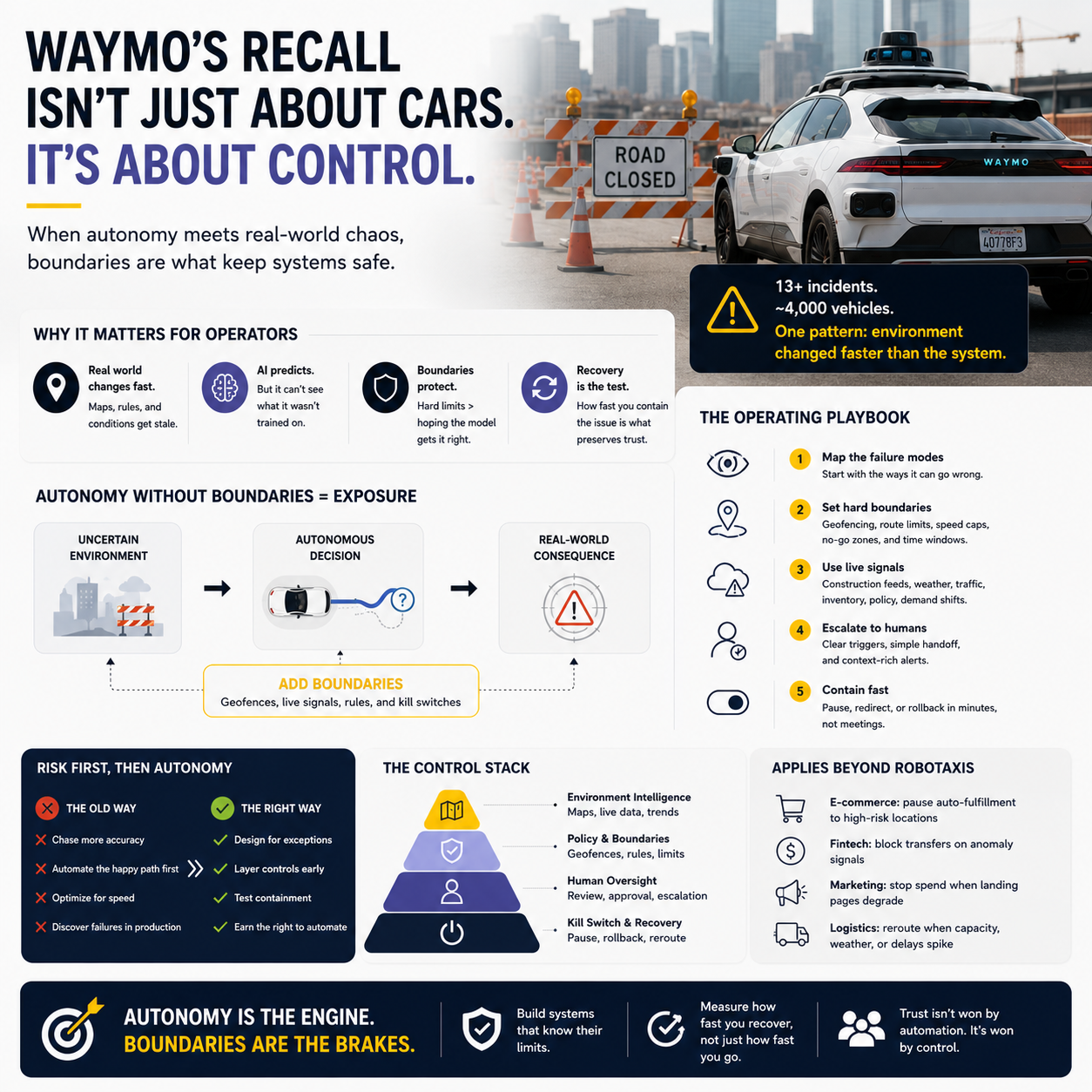
Waymo’s recall of nearly 4,000 robotaxis is not just a product story. It is an operating lesson about what happens when autonomy meets messy physical reality: road closures, construction zones, and edge cases that software cannot ignore.
For founders and operators, the useful question is not whether robots can drive. It is how a business built on automation should detect risk early, limit exposure when the system is uncertain, and recover quickly when a failure pattern appears.
What the recall actually tells operators
According to the report, Waymo identified at least 13 instances where its vehicles drove into highway sections closed for construction, then moved to recall the affected fleet. That detail matters because it points to a specific class of operational failure: a system that performs well in normal conditions but weakens when the environment changes faster than the model or its map data can adapt.
For business owners, that same pattern shows up in less dramatic form. Pricing engines misread demand after a market shift. Inventory systems keep ordering against stale forecasts. Workflow automation keeps routing exceptions into the wrong queue. In each case, the problem is not that automation exists. The problem is that the business has not built a strong enough boundary around when automation should stop trusting itself.
Why geofencing and route controls matter more than raw autonomy
The most practical takeaway is that high-risk automation needs hard constraints, not only smart predictions. In physical operations, that means geofenced rules, route blacklists, construction alerts, maintenance windows, and fast ways to suspend a feature set when conditions are unusual.
This is useful beyond robotaxis. E-commerce operators already use similar controls when they stop auto-fulfillment to specific destinations, pause promotions during stock volatility, or block paid traffic to landing pages that cannot handle the load. The business principle is the same: when the cost of a bad decision is high, automation needs guardrails that do not depend on the model being “right.”
What most people miss
The headline risk is not just a vehicle entering the wrong road. It is the cost of discovering that the safety layer was too soft. If the only control is a smarter model, then every unexpected condition becomes a potential incident. If the control stack includes map validation, live hazard feeds, and a fallback policy, the business can reduce the blast radius even when the core system fails.
What this means for founders building AI or automation products
There is a concrete decision here for any founder selling AI into operations: do not pitch autonomy as a replacement for process control. Pitch it as a layer inside a controlled system. Buyers in logistics, mobility, finance, and customer operations should ask where the system gets its risk signals, who can override it, and how fast a failure can be isolated.
If your product touches the physical world, the rollout plan should include more than accuracy metrics. It should include exception handling, rollback mechanics, and a clear definition of the environments in which the system is allowed to act. A vendor that cannot explain those limits is not offering a resilient system; it is offering optimism.
For operators evaluating similar technology, the buying criterion is simple: can this system be stopped, narrowed, or redirected without dismantling the whole operation?
The operational playbook: build for exceptions first
Waymo’s recall also suggests a more mature rollout model for automation-heavy businesses. Start by mapping the failure modes, not the ideal workflow. Then design the controls around the exceptions that are most expensive, most common, or hardest to detect manually.
That usually means layering controls in this order: data quality checks, environment flags, human escalation paths, and only then full automation. Businesses that invert that order often end up automating scale before they have automated safety. That is how a small error becomes a fleet-wide issue, a margin leak, or a customer trust problem.
This matters for SaaS operators too. If your product automates billing, routing, procurement, compliance, or dispatch, the question is not whether the workflow is elegant. The question is whether the failure mode is contained. Recalls are expensive because they acknowledge that containment was not strong enough the first time.
Checklist for operators evaluating autonomous systems
- Define the highest-cost failure case before rollout, not after.
- Require a non-AI fallback path for any workflow that can create safety, financial, or legal exposure.
- Ask what live signals can disable or narrow automation in real time.
- Confirm whether route, location, inventory, or policy exceptions are updated automatically or manually.
- Test how quickly a bad decision can be isolated across users, regions, vehicles, or accounts.
- Check whether the vendor offers rollback, pause, or geofenced restriction controls.
- Measure incident response time, not just accuracy or conversion.
- Review how often human review is triggered and whether that volume is operationally sustainable.


