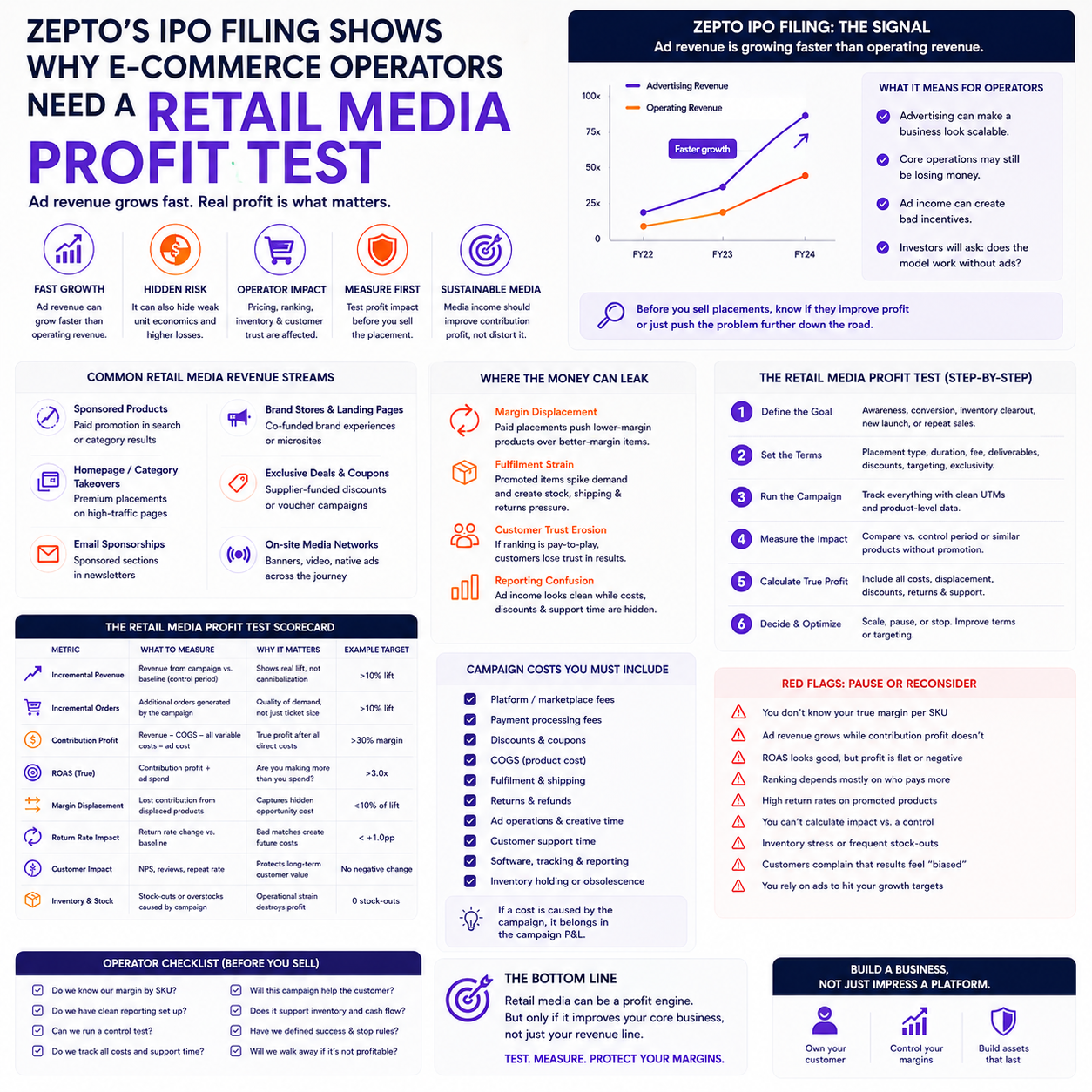
Zepto’s IPO filing, as reported by TechCrunch, contains a number every e-commerce operator should pause over: advertising revenue grew faster than operating revenue. That is not just a startup valuation detail. It is a warning about what happens when a commerce business starts earning money from visibility, placement and supplier promotion before the core operating model is fully proven.
For a small e-commerce seller, marketplace operator or digital commerce founder, the lesson is not “copy Zepto.” The lesson is sharper: before you add sponsored listings, supplier-funded campaigns, paid placement or internal ad inventory, you need to know whether media income is improving the business or hiding weak unit economics.
The real question is not whether ad revenue is attractive
Retail media looks tempting because it appears to create money from assets the business already has: product pages, search results, category pages, email lists, app screens, order confirmation pages and customer attention. A seller already has traffic. A marketplace already has suppliers. A delivery app already has demand signals. Turning those surfaces into advertising inventory feels efficient.
But that framing is incomplete. Retail media is not free margin. It changes incentives inside the business. Once suppliers can pay for exposure, the operator must decide whether product ranking is driven by relevance, margin, stock availability, delivery speed, sponsorship, or a mix of all five. That is where the operational risk begins.
Small operators usually do not have the governance layer that large platforms build around this. They often manage campaigns in spreadsheets, WhatsApp messages, manual invoices, Shopify apps, marketplace plugins, Klaviyo segments, Meta audiences and ad hoc banners. It works until it does not.
Then the store becomes noisy.
What Zepto’s filing should make operators measure
The useful signal from the Zepto report is the gap between fast growth and bigger losses, alongside advertising revenue growing faster than operating revenue. That combination matters because ad revenue can make a commerce story look more scalable than the underlying fulfilment engine really is.
For small businesses, the equivalent is not an IPO filing. It is your monthly management view. If your gross sales are rising, supplier-funded promotions are rising, but fulfilment costs, returns, discounts and customer support hours are also rising, you may be building a reporting illusion.
The core measurement question is simple: does media income improve contribution profit after it affects conversion, operations and customer trust?
That needs a stricter view than “we sold a banner for €500” or “a supplier paid for a homepage slot.” You need to track what changed because of the paid placement. Did the promoted product convert better? Did it reduce basket quality? Did it create substitutions from higher-margin items? Did it increase returns? Did it push out a product customers actually wanted? Did support tickets rise because sponsored products were over-promised or poorly stocked?
The operator version of retail media
Most small e-commerce operators will not build a retail media network. But many already run small versions of one without naming it.
A Shopify merchant may charge a brand for newsletter placement. A niche marketplace may sell featured vendor slots. A WooCommerce store may give paid homepage priority to a supplier. A cross-border seller may accept co-op marketing funds in exchange for pushing one manufacturer over another. A B2B distributor may sell category exposure to brands that want more account visibility.
These are retail media decisions. They just happen before the business has a media team.
The workflow usually starts manually: a supplier asks for exposure, the owner agrees, someone creates a banner, a discount code is added, an email is scheduled, and performance is judged by sales during the campaign period. That is not enough. The campaign may steal sales from products that would have sold anyway. It may increase low-margin orders. It may cause out-of-stock pressure. It may train customers to wait for promoted offers.
Retail media must be treated as an operating system, not a side deal.
Where the money can leak
The first leak is margin displacement. If a paid promotion pushes a lower-margin item ahead of a higher-margin item, the advertising fee must cover the lost product margin. Many small operators never calculate this. They treat the fee as incremental revenue and ignore substitution.
The second leak is fulfilment strain. Promoted products create demand spikes. If the warehouse, dropship supplier or 3PL is not ready, the campaign creates late shipments and customer service cost. A supplier-funded campaign can look profitable on the invoice and still damage the operating week.
The third leak is customer trust. Search and category pages are decision tools. If paid placement makes those pages less useful, repeat buyers notice. This is especially dangerous in niche stores where customers expect curation. The business may earn short-term supplier money while reducing the value of its own storefront.
The fourth leak is reporting confusion. Advertising income often sits in a different line from product revenue. If the owner does not allocate campaign-related discounts, design time, email cost, customer support time and fulfilment issues back to the campaign, the media programme looks cleaner than it is.
Build the profit test before selling the placement
A small operator does not need enterprise ad-tech to test this properly. The first system can be built with a campaign brief, clean UTM tagging, product-level margin data, stock checks and a post-campaign review. The important point is to decide what counts before the campaign starts.
Minimum data fields to capture
Every supplier-funded or sponsored placement should have a record with these fields:
- Campaign owner inside the business.
- Supplier or brand paying for exposure.
- Placement type: homepage, category page, search boost, email, bundle, checkout insert or marketplace feature.
- Fee or funding structure: fixed fee, rebate, co-op marketing credit, discount support or free stock.
- Promoted SKUs and their gross margin before the campaign.
- Stock available before launch.
- Baseline sales for the same SKUs or category before the campaign.
- Campaign discount, if any.
- Returns, cancellations and support tickets linked to the campaign.
- Net contribution after fulfilment, payment fees, discounts and support cost.
This can live in Airtable, Google Sheets, Notion, a lightweight CRM or a custom dashboard. The tool matters less than the discipline. If no one owns the campaign record, the business is not ready to sell repeated placements.
What most people miss
The unpopular answer is that some small stores should not automate retail media too early. Manual control is often better while the operator is still learning which placements damage trust, which suppliers overpromise, and which categories cannot handle sponsored distortion.
Automation makes sense when the rules are clear. Before that, it can scale bad incentives. A plugin that lets vendors buy featured placement may increase short-term revenue, but it can also turn the best category pages into paid clutter. A self-serve sponsorship form can save admin time while creating fulfilment problems no one priced into the campaign.
There is also a margin control issue. Manual approval lets the owner reject promotions for products with weak stock, poor delivery reliability, high return risk or low repeat purchase value. That judgment is not bureaucracy. It is margin protection.
So the automation boundary should be strict: automate tracking, tagging, reporting and invoice reminders first. Do not automate placement approval until the business has a written rule set for product eligibility, stock thresholds, margin floors and customer experience limits.
A practical scenario: the supplier-funded newsletter
Consider a small specialist e-commerce store with a strong email list and several recurring suppliers. One supplier offers a fixed fee for a dedicated newsletter and homepage feature. The offer looks attractive because the store can send the email with tools it already uses.
The wrong approach is to accept the fee, send the email, and report total sales from the promoted product.
The better approach is to run a controlled operator review. Before accepting, the store checks product margin, current stock, supplier replenishment speed, expected delivery time, historical return reasons and whether the product competes with a higher-margin house brand. It sets a campaign code, tags traffic, separates new orders from repeat customer orders, and records support tickets that mention the promoted item.
After the campaign, the operator does not ask only whether the supplier paid and sales increased. The operator asks whether the campaign improved net contribution without hurting repeat purchase behaviour or operational load. If the promoted product sold well but caused delayed orders, pulled sales away from better-margin products and consumed support time, the next campaign price must rise or the supplier must fund discount, stock and support risk.
That is the difference between selling attention and managing a media product.
The decision rule: when to accept supplier media money
A small commerce operator should accept sponsored placement only when four conditions are met.
First, the product must pass a margin floor after discounts, payment fees and fulfilment. If the media fee is the only thing making the campaign profitable, treat the campaign as risky. You are relying on the supplier payment to compensate for a weak sales mix.
Second, the stock position must be boring. Sponsored demand and fragile stock do not mix. If the item is low-stock, slow to replenish or dependent on a supplier with inconsistent delivery, the placement should be delayed or capped.
Third, the placement must not damage the customer’s decision path. A sponsored product can be visible without corrupting search relevance or category usefulness. If customers come to the store for expert selection, paid placement has to respect that promise.
Fourth, reporting must isolate incremental effect. Do not let total campaign sales become the only success metric. Compare against baseline, category substitution, gross margin, returns and support workload. A campaign that raises revenue while reducing contribution is not a win.
Metrics that belong on the dashboard
If retail media becomes recurring income, it needs its own dashboard. Not a vanity dashboard. An operating dashboard.
- Media revenue by placement: fixed fees, rebates, co-op funds or supplier credits split by campaign type.
- Product contribution after campaign cost: gross margin minus discounts, fulfilment, payment fees and allocated support cost.
- Substitution effect: whether promoted SKUs displaced higher-margin products in the same category.
- Stock failure rate: promoted orders delayed, cancelled or split because inventory was not ready.
- Return and complaint rate: campaign-linked orders compared with normal category behaviour.
- Repeat purchase signal: whether customers who bought through the campaign return at a normal rate.
- Approval rejection reasons: promotions declined because of margin, stock, delivery risk or customer fit.
These metrics help the operator avoid a common trap: celebrating advertising revenue while the fulfilment floor absorbs the pain.
30-day retail media readiness checklist
Use this before offering paid placements, sponsored listings or supplier-funded campaigns as a repeatable product.
- Days 1-3: Map every sellable surface. List homepage blocks, category pages, search results, newsletters, order inserts, marketplace vendor slots, checkout messages and post-purchase emails. Mark which surfaces affect customer decision quality most.
- Days 4-7: Set product eligibility rules. Define minimum margin, minimum stock cover, delivery reliability, return risk and customer fit. If a product fails these rules, it cannot be promoted for money.
- Days 8-10: Create one campaign record template. Include supplier, SKU, placement, fee, dates, discount, baseline sales, stock, margin, campaign code and owner.
- Days 11-15: Connect tracking. Use UTM links, discount codes, product tags or campaign IDs. Make sure orders can be tied back to the placement without manual guessing.
- Days 16-20: Build the contribution view. For each campaign, calculate product margin after discounts, payment fees, fulfilment and estimated support workload. Keep media revenue separate, then combine it only after the product economics are visible.
- Days 21-24: Run one controlled campaign. Choose a supplier and product with stable stock, clear margin and low service risk. Avoid your most sensitive category page for the first test.
- Days 25-27: Review displacement and complaints. Check whether the campaign moved demand away from better-margin products, increased support tickets, created delivery issues or changed return patterns.
- Days 28-30: Write the placement rules. Decide which placements can be sold, which require manual approval, which are off limits, and what price premium applies when the campaign creates operational risk.
The operator decision is not whether retail media is good or bad. The decision is whether the business can sell attention without weakening its own margin engine. Zepto’s filing is a large-company signal, but the control problem is familiar at small scale: when advertising money grows faster than the operating discipline around it, the numbers can flatter the business before the workflow is ready.


