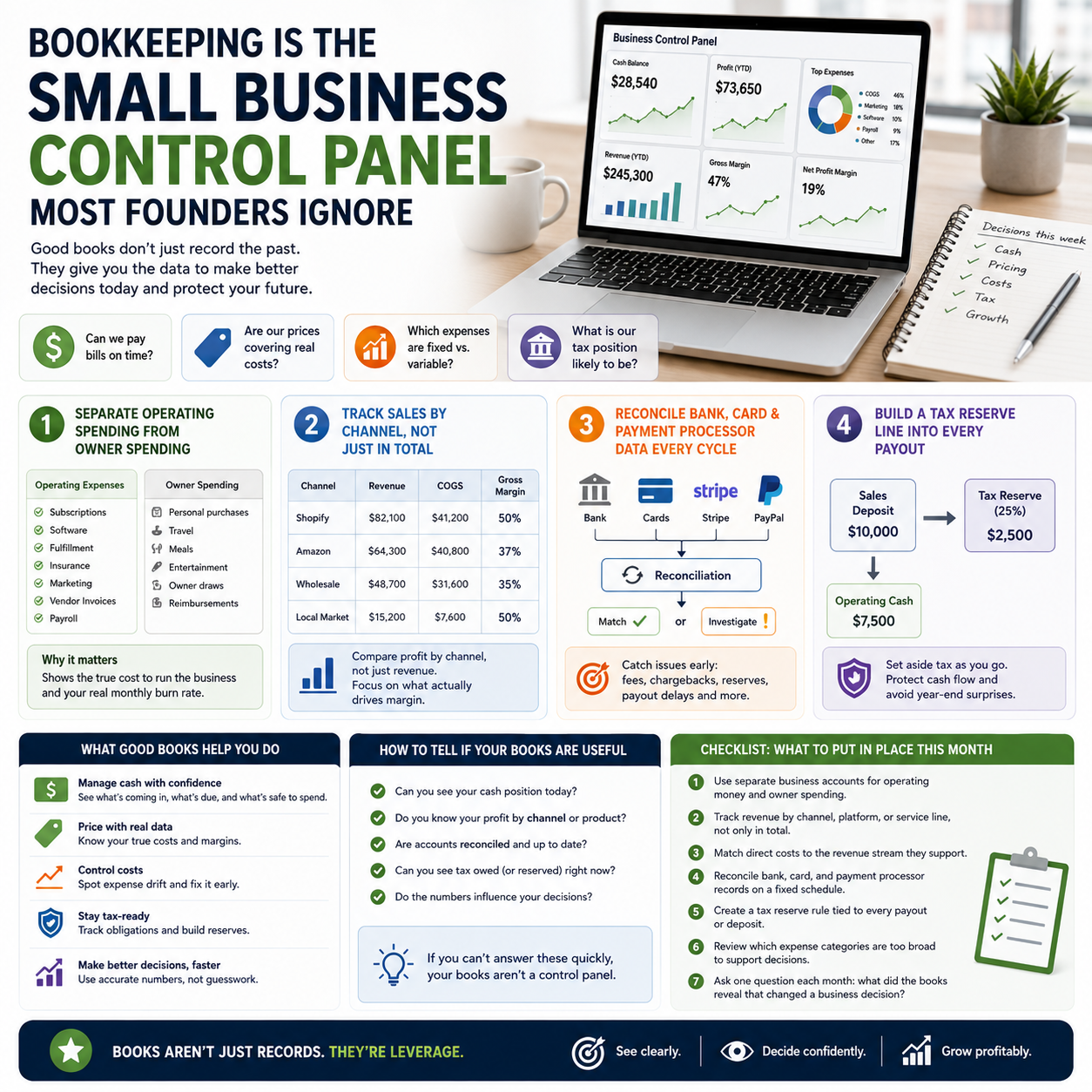
Bookkeeping is often treated as compliance work, but for a small business it is better understood as a control panel. The difference matters: a clean set of books does not just keep an accountant happy, it tells you when cash is tightening, when costs are drifting, and when a product line is quietly underperforming.
The practical question for founders is not whether bookkeeping matters. It is how to turn bookkeeping into a decision system that helps you manage cash, pricing, tax exposure, and operating discipline without adding unnecessary admin.
Why bookkeeping should be designed around decisions
Most founders inherit bookkeeping as a once-a-month task: send receipts, reconcile accounts, file taxes, move on. That approach produces records, but not much visibility. The better model is to define the decisions bookkeeping must support, then structure the records around those decisions.
For a small business, the highest-value decisions usually sit in four areas: can we pay bills on time, are our prices covering real costs, which expenses are fixed versus variable, and what is our tax position likely to be before the deadline arrives. If your books cannot answer those questions quickly, the system is too loose.
This is why bookkeeping examples matter. They are not just accounting exercises; they show where the business needs a rule, a category, or an automation to reduce confusion and catch errors earlier.
Example 1: separate operating spending from owner spending
One of the most common bookkeeping failures is mixing business costs with personal spending. That creates two problems. First, it makes profit look worse or better than it really is. Second, it hides the real monthly burn rate, which is the number founders need when planning payroll, inventory orders, or debt repayment.
A better approach is to keep a strict rule for account use and expense categorization. If the business pays for subscriptions, software, fulfillment, insurance, ads, and vendor invoices, those should flow through one business account and one bookkeeping workflow. Owner draws or reimbursements should be tagged separately so they do not distort operating performance.
For a founder, this is not about neatness. It is about being able to tell whether the business itself is producing cash or whether it is being subsidized by the owner.
Example 2: track sales by channel, not just in total
A single revenue line can hide a lot of bad news. A business selling through Shopify, Amazon, wholesale, and a local market may look healthy in total while one channel is eroding margin through fees, returns, or shipping costs. Bookkeeping that stops at total sales cannot reveal that.
A more useful setup is to code revenue by channel and attach the related direct costs to each one. That lets the founder compare gross margin by channel, not just top-line revenue. It also helps answer operational questions such as whether paid traffic should be scaled, whether a marketplace channel is worth the fee structure, or whether a wholesale account is actually profitable after discounts and fulfillment.
Once this is in place, bookkeeping becomes a source of channel-level decision-making instead of a rear-view summary.
What most people miss
The biggest bookkeeping mistake is not missing a receipt. It is failing to separate what the business sells from what the business consumes to sell it. In practical terms, that means founders often know revenue, but not unit economics. They know they made sales, but not whether a product line, service package, or sales channel is earning enough after fees, labor, shipping, and refunds.
If you do not map expenses to the activity that creates them, the books will stay technically accurate and strategically useless.
Example 3: reconcile bank, card, and payment processor data every cycle
Small businesses often collect money through multiple systems: bank transfers, card payments, payment processors, wallets, and marketplace payouts. Each platform has different timing, deductions, and fee structures. If you only reconcile the bank statement, you may miss chargebacks, withheld reserves, platform fees, or payout delays.
The operational value of reconciliation is speed. When the bank balance and the bookkeeping balance do not match, the business should know why within days, not months. That matters because cash decisions are made in real time. Inventory orders, advertising spend, contractor payments, and tax set-asides all depend on accurate cash visibility.
For e-commerce and service businesses in particular, reconciliation should be treated as a control, not a cleanup task. If it is left too long, small mismatches turn into expensive unravelling at month-end or year-end.
Example 4: build a tax reserve line into every payout
Bookkeeping is also the place where tax risk becomes visible early enough to manage. Many founders treat tax as a year-end event, then discover that the cash needed to pay it was spent during growth periods. A practical bookkeeping system sets aside a fixed percentage of receipts or profit into a tax reserve account as revenue lands.
This does not require complicated forecasting to start. The important part is consistency. Every time money comes in, the bookkeeping process should move a defined share into reserve so the business is not forced to raid operating cash later.
That reserve line also gives the owner a more truthful view of spendable cash. If the business can only afford payroll, inventory, or ad spend after reserving tax, that should be visible in the numbers before the decision is made.
How to tell whether your bookkeeping system is actually useful
A bookkeeping system is useful when it helps the owner act faster and with more confidence. It is not useful when it produces reports nobody reads or categories nobody trusts. The test is simple: can you use the books to answer a few operational questions without waiting for month-end cleanup?
If the answer is no, the fix is usually not more reports. It is better structure. That may mean tighter category rules, more frequent reconciliation, separate tracking for each sales channel, or automated syncing between payment systems and accounting software.
Small businesses do not need fancy finance teams to do this well. They need a bookkeeping process that reflects how money actually moves through the company.
Checklist: what to put in place this month
- Use separate business accounts for operating money and owner spending.
- Track revenue by channel, platform, or service line, not only in total.
- Match direct costs to the revenue stream they support.
- Reconcile bank, card, and payment processor records on a fixed schedule.
- Create a tax reserve rule tied to every payout or deposit.
- Review which expense categories are too broad to support decisions.
- Ask one question each month: what did the books reveal that changed a business decision?