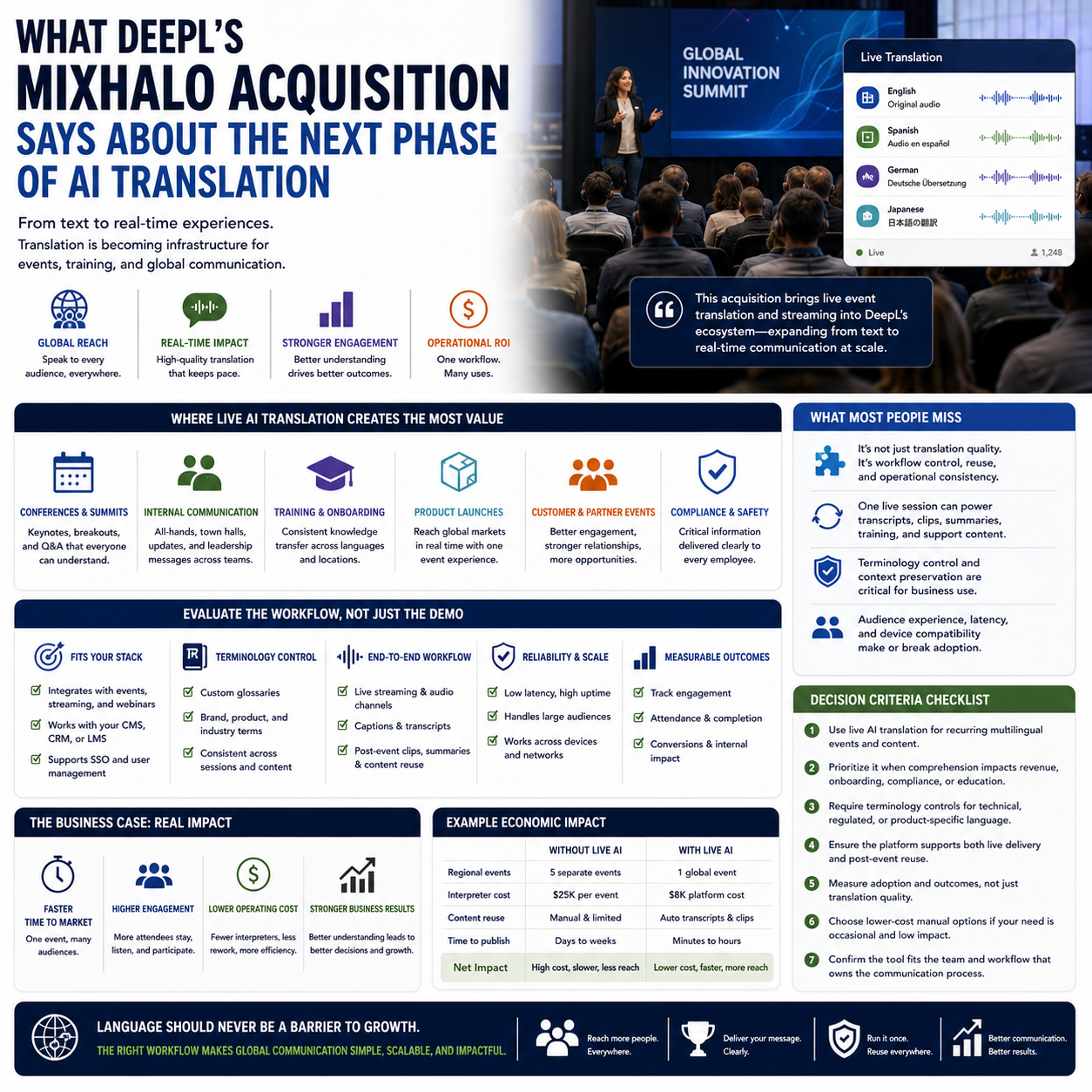
DeepL’s acquisition of Mixhalo is more than a startup headline. It points to a specific business direction: translation is moving from text-only tools into live, high-value communication workflows where timing, context, and audience experience matter. For operators, the question is no longer whether AI can translate, but where translation quality justifies a budget.
Why this deal matters for operators
DeepL is known for machine translation. Mixhalo brings live-event audio streaming and translation into the picture, which expands the use case from documents and chat to conferences, internal town halls, product launches, training sessions, and customer events. That shift matters because live communication has a different economic profile than standard content translation.
When a business needs multilingual communication in real time, the cost of a bad experience is not just a mistranslated sentence. It can be lost attention, weaker attendee engagement, lower adoption of a product message, or a training session that fails to land across markets. That means the buyer is often not marketing alone. It may be event operations, internal communications, sales enablement, or customer education.
The practical business case: where AI translation earns budget
The strongest use cases are those where translation is tied to revenue, retention, or operational consistency. A founder or operator should think in workflows, not features.
For example, a global SaaS company running a customer summit may need live interpretation for keynote sessions, multilingual audio for breakout tracks, and translated Q&A support. A manufacturer with distributed teams may use the same stack for safety briefings and onboarding. A marketplace or e-commerce brand may use live translated product launches to reach international sellers or partners without producing separate event programs for every language.
The decision is usually not whether to localize everything. It is whether live multilingual access reduces friction enough to justify the tooling, integration, and support cost.
What most people miss
The real value in live translation is not just language coverage. It is operational control.
Businesses that rely on ad hoc interpretation often face hidden costs: last-minute vendor bookings, inconsistent terminology, manual coordination, and a poor way to reuse content after the event. A platform-based workflow can turn one live session into a reusable asset. The same transcript, translation layer, and audio stream can feed post-event clips, internal summaries, support documentation, and sales follow-up content.
That is why this category is interesting for companies with repeatable communication programs. If you host quarterly all-hands meetings, recurring training, regional partner events, or product webinars, the better question is whether translation can be embedded into the communication stack rather than handled as a one-off service.
How to evaluate the stack before buying
Operators should look at the workflow around the translation layer, not just the demo quality. Ask how the system fits into registration, streaming, captioning, transcription, and post-event content use. If the tool solves only the live moment but creates manual cleanup afterward, the total cost may be higher than expected.
Also check whether the solution supports terminology control. In business settings, words like product names, compliance terms, and technical phrases need consistency. If the translation engine cannot preserve terminology across sessions, the value drops quickly for enterprise use.
Another issue is audience experience. Some tools are fine for a small internal audience but break down when used across larger external events. Latency, device compatibility, and audio routing matter more than most buyers assume. A language layer that looks impressive in a pitch can still create friction at scale if attendees struggle to connect or switch channels.
What this signals about the market
The acquisition suggests that AI translation vendors are competing on workflow ownership, not just model quality. The winners will likely bundle translation with distribution, audio, event delivery, and enterprise communications. That creates a stronger business case than standalone machine translation because it locks into a repeatable process with measurable usage.
For small businesses, that does not mean buying enterprise-grade tooling too early. It means identifying where multilingual communication already costs time or money. If you localize webinars manually, rely on a patchwork of interpreters, or keep re-running the same sessions for different markets, the workflow itself may be the problem. In that case, automation is about reducing operational drag, not replacing people.
For larger operators, the acquisition is a reminder that language tech is becoming infrastructure. It sits closer to events, support, training, and sales operations than to a simple translation widget. That changes budgeting: the buyer may come from operations or revenue teams, while the value shows up in attendance, comprehension, conversion, or employee alignment.
Decision criteria for founders and operators
- Use live AI translation if you run recurring multilingual events and can reuse the workflow across sessions.
- Prioritize it if the cost of poor comprehension affects revenue, onboarding, compliance, or customer education.
- Require terminology controls if your business uses product-specific, technical, or regulated language.
- Check whether the system handles both live delivery and post-event reuse, such as transcripts, clips, and summaries.
- Measure adoption and completion, not just translation quality: attendance, watch time, follow-up conversions, and internal engagement.
- Avoid overbuying if your multilingual need is occasional and can still be handled through lower-cost manual support.
- Ask who owns the workflow internally: events, marketing, sales enablement, or operations, and make sure the tool fits that team’s process.


