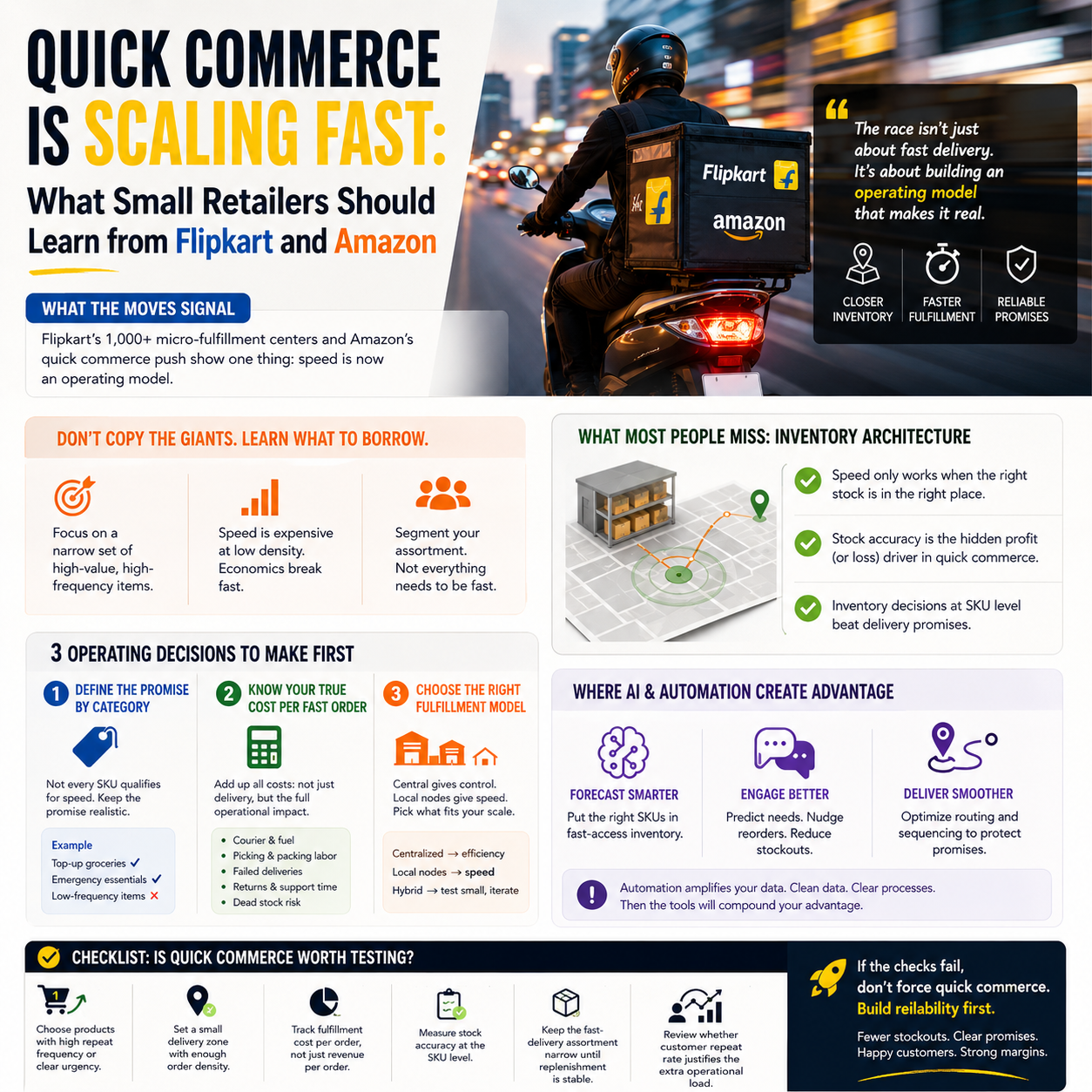
Quick commerce is no longer just a race between large platforms. Flipkart’s expansion past 1,000 micro-fulfillment centers, alongside Amazon’s accelerated push in India, shows how fast delivery is becoming an operating model rather than a marketing promise. For smaller retailers and e-commerce operators, the useful question is not whether to copy the giants, but which parts of the model can be borrowed without blowing up margins.
What the Flipkart and Amazon moves actually signal
Both companies are building for speed, but the real signal is operational: inventory must be placed closer to demand, picking must be faster, and delivery promises must be backed by a system that can survive peak traffic, substitutions, and returns. A business that sells online is now being judged less on how broad its catalog is and more on how reliably it can convert local demand into immediate fulfillment.
For founders, this matters because customer expectations are shifting from “arrives tomorrow” to “arrives when I need it.” That changes where margins disappear. The cost center is no longer only ads or marketplace fees; it is the combination of stock placement, inventory turnover, labor scheduling, and last-mile execution.
Why small businesses should not copy the model blindly
Quick commerce sounds attractive because speed can increase conversion. But the economics are fragile if your assortment is too wide, your order density is too low, or your unit margins are thin. A small retailer that promises same-hour delivery without enough local demand usually ends up paying for speed through waste, failed deliveries, or overstaffing.
The smarter move is to treat quick commerce as a segmentation strategy. You do not need every product to be fast. You need to identify a narrow set of items that benefit from immediacy and can sustain the operational cost. That might be top-up grocery items, emergency essentials, high-repeat consumables, or products that are frequently bought within a local catchment area.
If you are not sure whether to invest, the question is simple: can the faster promise create enough repeat orders to justify inventory positioning and delivery complexity? If the answer is no, it is usually better to keep the broader catalog and improve standard fulfillment reliability first.
What most people miss
Most conversations about quick commerce focus on customer convenience. Operators should focus on inventory architecture. Speed only works when the right stock is in the right place at the right time, and that means your warehouse design, replenishment frequency, and demand forecasting matter more than your checkout page.
This is where smaller businesses often overestimate their readiness. They assume the challenge is delivery speed, when the real challenge is stock accuracy. If an item shows as available but is missing at the picking stage, the cost is not just a canceled order. It is a lost delivery slot, a customer service interaction, and often a margin hit from expedited replacement handling.
That is why the winners in quick commerce are not just logistics-heavy companies. They are businesses that can make inventory decisions at SKU level. Which products sit in micro-storage? Which items are replenished daily? Which products should never be promised for ultra-fast delivery because they tie up capital or create substitution risk?
The operating decisions founders should make now
There are three decisions worth making before any investment in faster delivery:
First, define the delivery promise by category, not by store. A store may sell hundreds of SKUs, but only a small fraction should qualify for rapid dispatch. This keeps service levels realistic and prevents the business from building expensive speed into low-frequency items.
Second, map the true cost per fast order. That cost is not only courier expense. It includes picking labor, packing material, failed handoffs, reverse logistics, customer support time, and the dead stock risk created by pre-positioned inventory. If you cannot estimate this at order level, you cannot manage it at scale.
Third, decide whether the business is better served by central fulfillment or local nodes. Central fulfillment gives better inventory control; local nodes give speed. Many small operators will do better with one central stock point and a limited fast-moving assortment than with a network of underused mini-warehouses.
Where AI and automation fit into the model
The MoEngage story points to another layer of change: customer engagement is becoming more automated and more individualized. For quick commerce, that means the next advantage may not come from delivery speed alone, but from better prediction of what a customer will need before they order it.
For smaller operators, automation is useful in three places. Forecasting can help decide which SKUs belong in fast-access inventory. Messaging can reduce failed purchases by nudging repeat orders before stockouts happen. And routing systems can improve delivery sequencing so that the promise time remains realistic during busy periods.
But AI should support operational discipline, not replace it. If your catalog data is messy or your stock records are inconsistent, automation will only scale the errors faster. The businesses that benefit most are the ones that already know their top-moving SKUs, replenishment cadence, and local demand patterns.
How to decide whether quick commerce is worth testing
If you want to test a faster delivery model without overcommitting, run it as a controlled offer. Limit the product set, limit the delivery radius, and measure whether the economics improve after the first wave of orders. The point is not to chase platform-level scale. The point is to learn whether speed increases repeat purchase enough to offset the extra handling cost.
Use these criteria before expanding:
- Choose only products with high repeat frequency or clear urgency.
- Set a small delivery zone where order density can support faster handoff.
- Track fulfillment cost per order, not just revenue per order.
- Measure stock accuracy at the SKU level before promising rapid delivery.
- Keep the fast-delivery assortment narrow until replenishment is stable.
- Review whether customer repeat rate improves enough to justify the extra operational load.
If those checks fail, the right move is not to force quick commerce. It is to improve standard fulfillment, reduce stockouts, and keep your delivery promise simple and trustworthy.


