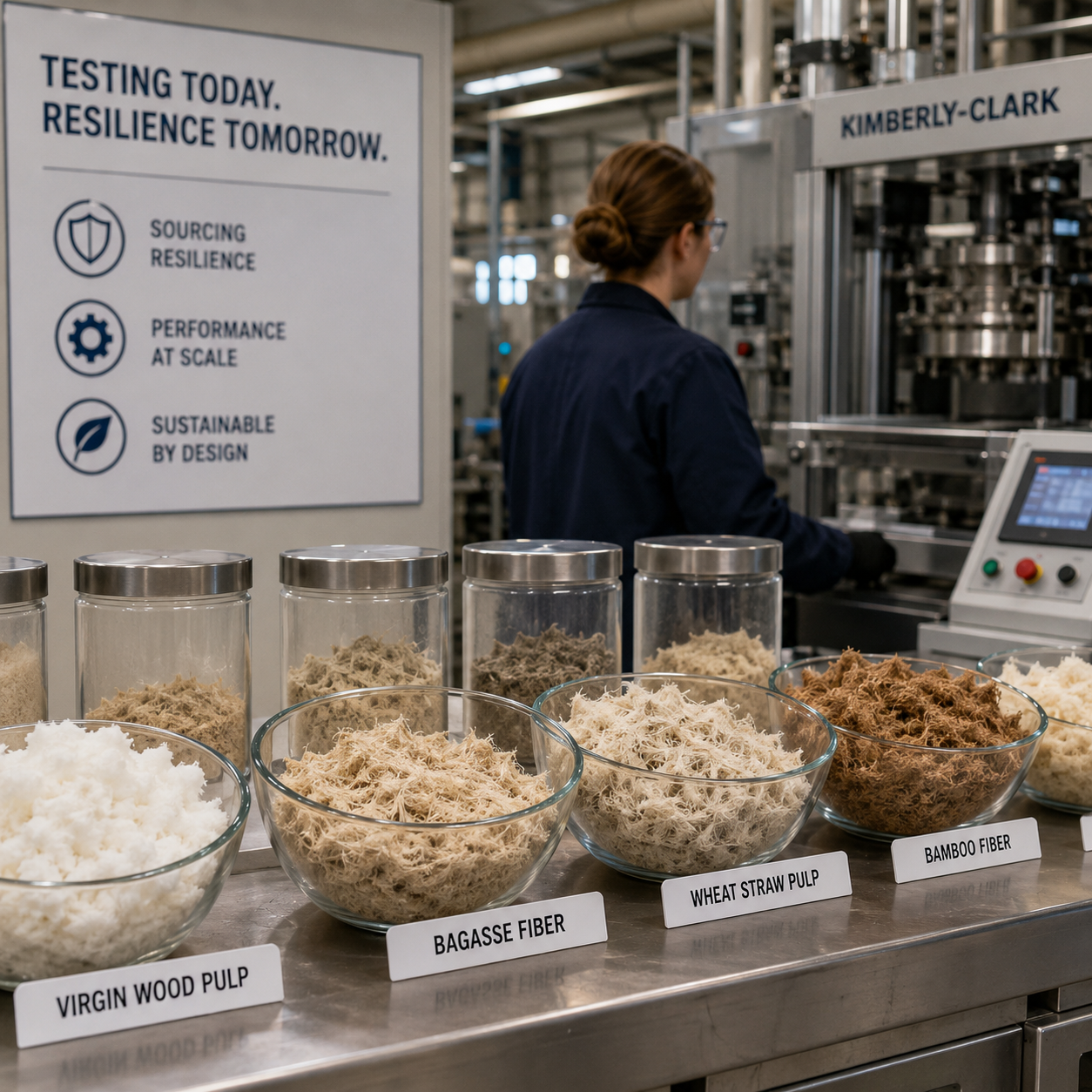
Alternative fibers can reduce dependence on a volatile raw material, but substituting an input is not simply a procurement decision. It can change product performance, machine behavior, supplier requirements, capital needs and the credibility of environmental claims. For manufacturers, the important question is therefore not whether an alternative material looks cheaper or more sustainable in a laboratory. It is whether the material can perform consistently, at commercial speed and volume, without transferring risk elsewhere.
Kimberly-Clark’s testing of new fiber sources offers a useful model for this decision. According to Supply Chain Dive, the company has opened a pilot facility to test alternative fibers as it seeks greater sourcing resilience and sustainability. The reported initiative establishes the business context, but it does not prove that any particular fiber will reach commercial adoption. Manufacturers should treat such a pilot as an evidence-building stage between promising material and procurement commitment.
Define the volatility the alternative must actually hedge
Natural forest fiber prices can be affected by harvest conditions, energy and transportation costs, processing capacity, regulation and competition for supply. An alternative input may diversify that exposure, but only if its own cost drivers are sufficiently different. Replacing one commodity with another whose availability depends on the same geography, energy market or logistics corridor provides limited protection.
Begin with an exposure map for the incumbent material. Record price-reset mechanisms, lead times, minimum order quantities, supplier concentration, origin regions and the cost of emergency purchases. Separate the quoted material price from freight, preparation, storage, yield loss and working capital. This creates the baseline against which an alternative should be assessed.
Next, test whether the candidate fiber is a true hedge. Questions include whether feedstock supply is seasonal, whether processing is concentrated among a few vendors, and whether other industries compete for the same material. Procurement teams should compare price correlation and disruption scenarios rather than relying on a single attractive quotation. The goal need not be total replacement: a qualified second input can create negotiation leverage and preserve production during disruption even when it is not always the lowest-cost option.
Translate product requirements into input specifications
A fiber cannot be qualified through its name or origin alone. Technical and operations teams need a specification covering the properties that influence both processing and the finished product. Depending on the application, these may include fiber length distribution, strength, moisture, cleanliness, absorbency, brightness, chemical composition and allowable contamination.
Specifications should distinguish three levels: non-negotiable safety or regulatory limits, process limits required for stable production, and desirable attributes that can be adjusted through formulation. This prevents teams from rejecting a viable input because it differs from the incumbent in an irrelevant way, while also preventing procurement savings from overriding critical quality requirements.
Supplier data should be verified through incoming inspection and repeated lots. A sample prepared for a development trial may not represent normal commercial output. Pilot plans should therefore include material from different batches, production periods and, where relevant, harvest seasons. Variation matters as much as average performance.
Validate quality and equipment compatibility together
Finished-product testing and process testing should run in parallel. A material may produce an acceptable laboratory specimen yet create excessive dust, deposits, breaks or cleaning requirements on production equipment. Conversely, a stable process is not enough if customers notice changes in softness, strength, appearance or absorbency.
Create a test matrix that compares the incumbent input with several alternative-fiber blend ratios. Measure critical product attributes using the same methods and acceptance limits applied to commercial goods. Include aging, storage and transport tests where performance may change over time. If the product is sold through consumer or customer specifications, conduct controlled evaluations before assuming technical equivalence translates into market acceptance.
On the equipment side, record throughput, downtime, waste, energy and water use, changeover duration, maintenance demand and consumable wear. Identify whether the alternative requires different pulping, refining, drying, conveying or filtration conditions. Temporary pilot modifications should be documented because they can conceal capital requirements that become material at full scale.
Quality validation must also cover traceability and compliance. Teams need agreed methods for identifying lots, isolating nonconforming material and linking finished products back to alternative-fiber deliveries. No sourcing hedge is valuable if it increases recall or regulatory risk.
Calculate pilot economics beyond purchase price
The correct comparison is total cost per saleable unit, not cost per tonne of incoming fiber. Pilot economics should include preprocessing, additives, yield, scrap, slower line speed, extra labor, quality testing, storage and disposal. Freight density and moisture can also change the effective cost of usable material.
Capital deserves separate treatment. Some candidates may run with parameter changes; others may require handling systems, preparation equipment, controls or wastewater upgrades. Estimate both the initial investment and the operational cost of maintaining a dual-material capability. A flexible line may cost more initially but preserve the option to switch inputs as markets move.
Use scenarios rather than a single forecast. Compare normal incumbent pricing, a price spike, supply interruption and alternative-fiber scarcity. Include the value of avoided downtime and improved supplier negotiating power, while keeping those benefits distinct from directly measured savings. This shows whether the project is attractive only during extreme volatility or robust under ordinary conditions.
Test suppliers as rigorously as the fiber
Commercial adoption depends on a supply network capable of reproducing pilot results. Manufacturers should verify available capacity, expansion plans, quality systems, lead times, business continuity arrangements and the supplier’s own feedstock dependencies. Claimed capacity is not necessarily capacity contractually available to one buyer.
Qualification should include delivery trials and a ramp schedule. Confirm packaging, transport conditions, storage life and procedures for specification drift. Where possible, avoid creating a new single-source dependency. Dual suppliers, multiple origins or an approved incumbent-alternative blend range can provide more resilience than switching completely to one novel source.
Sustainability claims require equal discipline. Document the chain of custody, methodology, boundaries and evidence behind claims about forest impact, emissions, water or waste. A material described as non-forest or alternative is not automatically better across every environmental measure. Marketing language should follow verified evidence and applicable claim rules, not precede them.
Set explicit gates for commercial adoption
A pilot should conclude with a decision package, not a successful demonstration event. Before scale-up, require evidence that the fiber meets specification across multiple lots; finished products pass quality and customer tests; equipment runs at an acceptable sustained rate; and total cost remains viable under defined scenarios. Supplier volume, continuity and traceability must also support the planned ramp.
Capital approval should identify modifications, commissioning risk and the cost of reversing course. Sustainability statements need documented substantiation. Finally, assign owners and thresholds for the commercial ramp, including allowable defect rates, waste, line losses and delivery performance.
A staged outcome is often preferable to an immediate conversion. Manufacturers can approve the material for limited products, selected facilities or a defined blend ratio while retaining the incumbent source. Volume should increase only after production data confirms pilot assumptions. Stop conditions—such as persistent quality failures, unstable supply or excessive conversion cost—are as important as success criteria.
Kimberly-Clark’s reported facility illustrates the strategic value of creating a controlled environment for alternative-fiber testing. Its broader lesson is not that alternative fibers will necessarily outperform forest fiber. It is that manufacturers can buy better information before making procurement, equipment and product commitments. A credible hedge emerges only when the new input is technically repeatable, economically defensible and supplied through a network that remains dependable when volatility arrives.