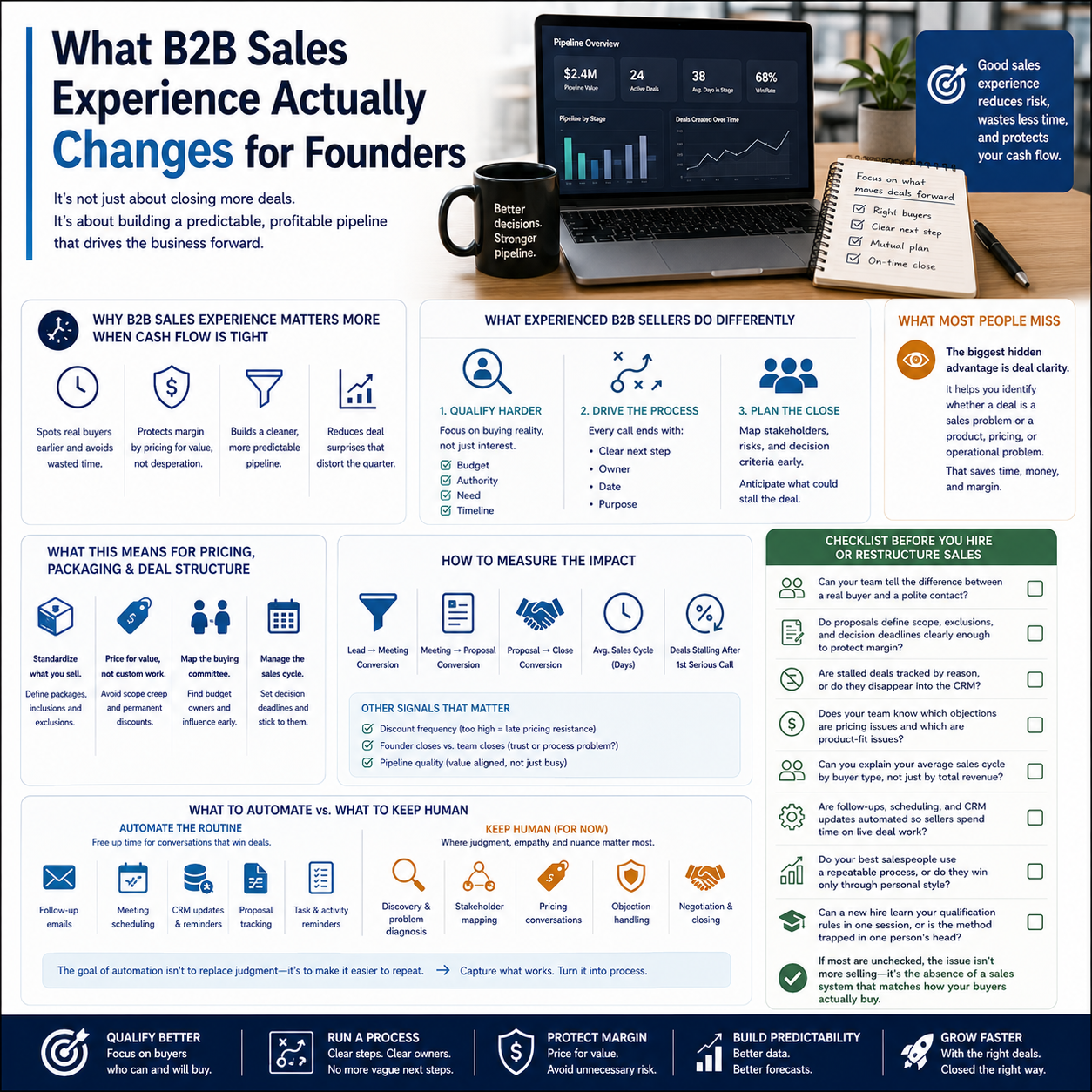
If you run a small business selling to other businesses, “sales experience” is not just about charisma or confidence. It changes how fast you qualify leads, how you price, how long deals stay open, and whether your pipeline is built on real buying intent or wishful thinking.
The useful question for founders is not whether B2B sales experience is valuable in theory. It is where it changes outcomes in the sales process, what it reduces in operational risk, and which parts of the work can be systemized without losing deal quality.
Why B2B sales experience matters more when cash flow is tight
In a small company, one weak deal can distort the entire quarter. A founder with B2B sales experience usually spots patterns earlier: who is actually a decision-maker, which objections are real, which leads are not ready, and where the deal will get stuck. That makes the pipeline more predictable.
For operators, the practical value is not abstract sales skill. It is the ability to prevent time leakage. Every hour spent nurturing a lead that cannot buy is an hour not spent on stronger accounts, better follow-up, or cleaner proposals. In a small team, that tradeoff matters because the same person often handles prospecting, demos, quoting, and account follow-up.
Experience also changes the margin equation. When a founder understands how buyers compare vendors, they can avoid underpricing too early just to “win the account.” That matters in B2B because discounts often become permanent, while support load and implementation effort keep rising.
What experienced B2B sellers do differently in the funnel
Strong B2B sellers do not just “sell better.” They manage the funnel with more discipline. That usually shows up in three places: lead qualification, deal progression, and close planning.
First, they qualify against buying reality rather than interest. A prospect asking for information is not the same as a prospect with budget, authority, a timeline, and a problem that is painful enough to fix now. Experience helps a founder separate curiosity from commercial intent before the pipeline gets polluted.
Second, they structure the next step. Many small businesses lose deals because each conversation ends vaguely, with no clear owner, no date, and no decision path. Experienced sellers are less likely to leave a call without knowing what has to happen before the next meeting.
What most people miss
The biggest hidden advantage is not closing style. It is deal clarity. B2B sales experience helps you identify whether a deal is really a sales problem or a product, pricing, or operational problem. If the buyer wants custom features, procurement approval, onboarding changes, or legal review, the issue may not be persuasion at all. It may be that your business has not defined what kind of deal it can profitably serve.
That distinction saves money. It prevents founders from throwing more calls, more discounting, or more follow-up at an account that is structurally a poor fit.
What this means for pricing, packaging, and deal structure
For many small businesses, B2B sales experience becomes most visible in pricing conversations. Less experienced teams often sell too much customization too early, because they are trying to reduce resistance. The result is messy scope, slow approvals, and margins that are hard to defend.
An experienced operator usually pushes toward clearer packaging. Instead of building every proposal from scratch, they define which problems are standard, what is included, what is excluded, and when a custom build requires a higher price. That improves forecasting because fewer deals are negotiated from zero.
It also affects sales cycle management. If your average buyer needs internal sign-off, the person selling has to know how to map stakeholders, budget owners, and implementation risks. Without that, the team may mistake “positive conversation” for “active deal.” B2B sales experience reduces that illusion.
For founders deciding whether to hire senior sales talent, this is the core question: do you need someone who can simply talk to prospects, or someone who can design a repeatable commercial process around how your buyers actually purchase?
How to measure whether sales experience is helping
The right metrics are operational, not vanity metrics. If you want to know whether B2B sales experience is improving the business, track the parts of the funnel that reveal judgment, not just activity.
Look at lead-to-meeting conversion, meeting-to-proposal conversion, proposal-to-close conversion, average sales cycle length, and the percentage of deals that stall after the first serious conversation. If those numbers improve, the experience is doing work. If activity increases but the pipeline stays noisy, the issue may be execution discipline rather than experience.
Another useful signal is discount frequency. If the team keeps cutting price late in the process, it may mean they are qualifying poorly or selling value too late. Experienced sellers are usually better at detecting pricing resistance earlier, before the deal becomes a salvage operation.
Founder-led sales should also be compared against team-led sales. If the founder closes deals that reps cannot, the company may have a messaging problem, a qualification problem, or a trust-transfer problem. Experience helps diagnose which one it is.
What small businesses should automate and what they should not
Not every part of B2B sales should stay manual. Routine follow-up, meeting scheduling, CRM updates, and proposal reminders can usually be automated. That gives the sales lead more time for conversations that actually change deal probability.
But the highest-value parts of B2B selling should stay human longer than many teams assume. Discovery calls, stakeholder mapping, pricing conversations, and objection handling are often where experience matters most. Automating those too early can create a polished process that still fails to learn what buyers are telling you.
The best use of automation is not replacing judgment. It is making judgment easier to repeat. For example, a simple workflow that tags deal stage, follow-up date, budget status, and next decision owner can prevent the common small-business problem of forgetting why a deal looked promising in the first place.
That matters because B2B sales experience becomes more valuable when it is captured in process. If your best seller knows how to qualify well, that logic should be turned into a repeatable checklist, a CRM field set, or a call review template.
Use this checklist before you hire or restructure sales
- Can your team tell the difference between a real buyer and a polite contact?
- Do proposals define scope, exclusions, and decision deadlines clearly enough to protect margin?
- Are stalled deals tracked by reason, or do they disappear into the CRM?
- Does your team know which objections are pricing issues and which are product-fit issues?
- Can you explain your average sales cycle by buyer type, not just by total revenue?
- Are follow-ups, scheduling, and CRM updates automated so sellers spend time on live deal work?
- Do your best salespeople use a repeatable process, or do they win only through personal style?
- Can a new hire learn your qualification rules in one session, or is the method trapped in one person’s head?
If the answer to most of these is no, the issue is not simply “more selling.” It is the absence of a sales system that matches how your buyers actually buy.