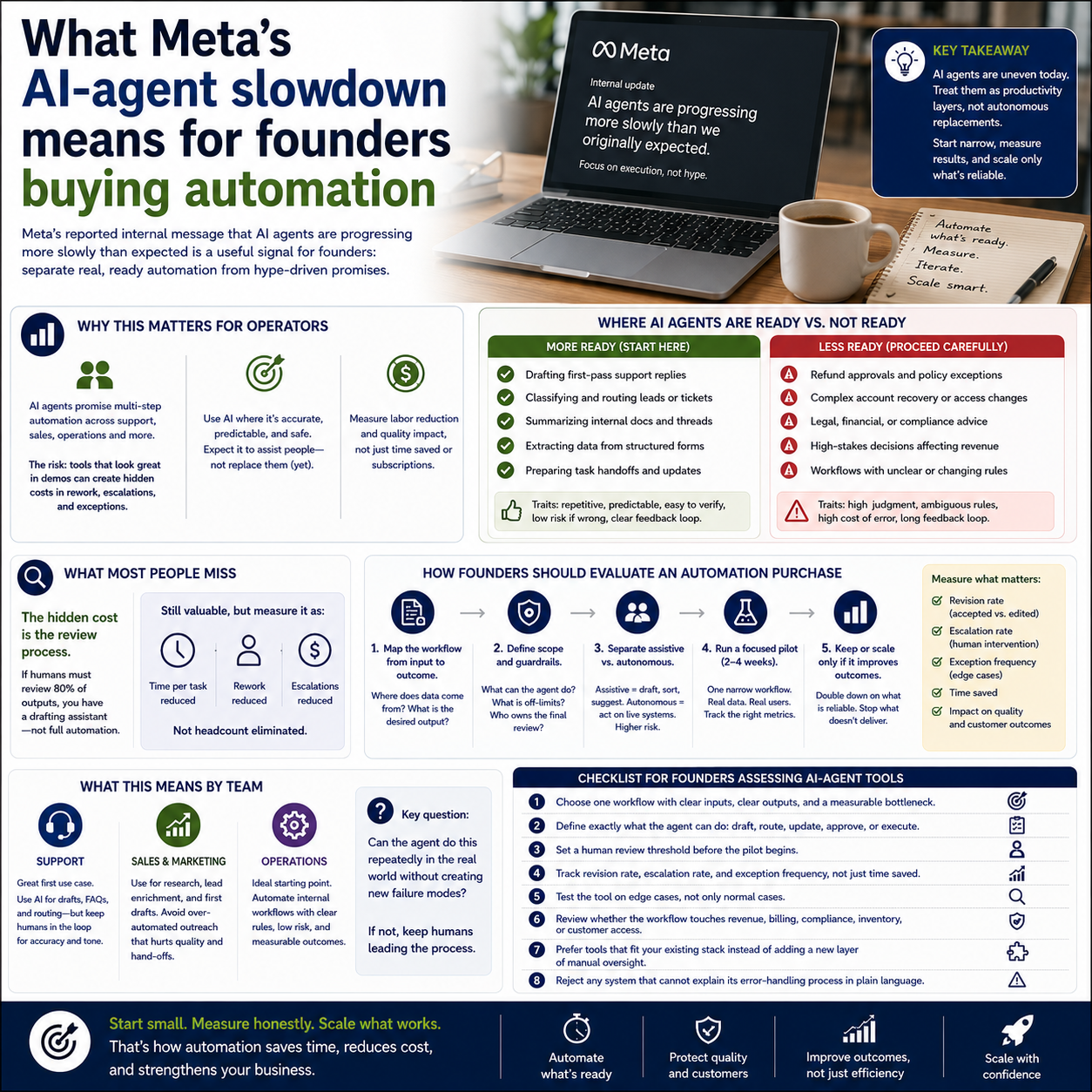
Meta’s reported internal message that AI agents are progressing more slowly than expected is not just a Big Tech story. For founders, it is a useful signal about where automation is genuinely ready to reduce labor, and where the hype still outruns operational reality.
If you run an e-commerce business, agency, software company, or lean operations team, the question is not whether AI will matter. The question is which workflows are stable enough to automate now, which ones still need review, and how to avoid buying tools that create more cleanup than value.
Why this matters for operators
AI agents are attractive because they promise to complete multi-step work with less supervision: answering customer questions, routing tickets, generating reports, updating records, or triggering internal tasks. That promise is useful only if the system is accurate, predictable, and safe enough to trust with real workflows.
Meta’s reportedly slower-than-hoped progress is a reminder that “agentic” automation is still uneven. Founders should treat current AI tools as productivity layers, not autonomous staff replacements. That distinction matters because the wrong assumption changes hiring plans, support design, quality control, and vendor budgets.
For smaller businesses, the practical risk is not that AI fails completely. It is that it works well in demos, partially in production, and then quietly creates hidden costs through rework, escalations, and exception handling.
Where AI agents are ready and where they are not
The safest use cases today are narrow, repetitive, and easy to verify. Think of tasks with clear inputs, clear outputs, and a short feedback loop. If a human can spot-check the result in under a minute, the workflow is a much better candidate for automation.
Examples include drafting first-pass replies for support, classifying inbound leads, summarizing internal documents, extracting fields from structured forms, or preparing basic task handoffs. These jobs do not need perfect reasoning; they need consistency and speed.
Less mature use cases are those that require layered judgment, unclear business rules, or high-stakes decisions. That includes refund approvals, policy exceptions, complex account recovery, legal or financial advice, and any workflow where a wrong step can create a customer dispute, compliance issue, or margin loss.
What most people miss
The hidden cost of an AI agent is not the subscription fee. It is the review process you have to build around it. If you need a human to approve 80% of outputs, then you do not have a fully automated workflow; you have a drafting assistant with a quality-control layer.
That is still valuable, but it should be measured as labor reduction, not headcount elimination. Founders who ignore that distinction often overbuy tools and underinvest in process design.
How founders should evaluate an automation purchase
Before adopting any AI agent tool, map the workflow from input to outcome. Ask where the data comes from, what the agent is allowed to change, what happens when it is uncertain, and who owns the final review. If those answers are vague, the system is not ready for production use.
Also separate “assistive” automation from “autonomous” automation. Assistive tools draft, sort, summarize, or recommend. Autonomous tools act on live systems. The second category carries much more operational risk because a mistake can affect customers, revenue, inventory, payroll, or account access.
For small teams, the right buying criterion is usually not feature depth. It is whether the tool reduces a measurable bottleneck without requiring a new layer of management. If a platform needs constant prompt tuning, manual exception handling, and frequent rewrites of business rules, the operating burden may outweigh the benefit.
A practical way to test readiness is to run a limited pilot on one narrow workflow for two to four weeks. Measure how many outputs can be accepted without revision, how often humans need to intervene, and what happens when edge cases appear. That gives you a much better signal than a vendor demo.
What this means for support, sales, and operations teams
Customer support teams can usually get value first because the work is structured and repeatable. But even there, AI should be used carefully. A draft reply that sounds confident but gets the policy wrong can create more friction than a slower human response.
Sales teams should be cautious about using agents for outbound messaging beyond first drafts and lead enrichment. Automation can help with sorting and research, but over-automated outreach often produces generic messages, weaker qualification, and messy handoff problems between marketing and sales.
Operations teams are often the best place to start because internal workflows are easier to constrain. Examples include document processing, purchase order intake, vendor follow-up, and internal knowledge retrieval. These use cases tend to have clearer success criteria and lower customer-facing risk.
The key operational question is not whether AI can do the task once. It is whether it can do it repeatedly under real-world conditions without creating new failure modes.
How to decide whether to wait or buy now
Founders do not need to wait for AI agents to become perfect. They do need to buy only where the downside is manageable and the workflow is measurable. The best early wins will usually be in low-risk, high-volume tasks where partial automation still creates meaningful time savings.
If a vendor claims the tool can replace a role, ask what happens when the agent is uncertain, wrong, or blocked by an exception. If the answer depends on “human oversight anyway,” the real product may be workflow support, not replacement. That can still be useful, but it changes the business case.
In other words, the smartest move is to build an automation portfolio, not a single automation bet. Some systems should be fully manual, some semi-automated, and some deeply integrated. The mix should reflect risk, volume, and the cost of failure.
Checklist for founders assessing AI-agent tools
- Choose one workflow with clear inputs, clear outputs, and a measurable bottleneck.
- Define exactly what the agent can do: draft, route, update, approve, or execute.
- Set a human review threshold before the pilot begins.
- Track revision rate, escalation rate, and exception frequency, not just time saved.
- Test the tool on edge cases, not only normal cases.
- Review whether the workflow touches revenue, billing, compliance, inventory, or customer access.
- Prefer tools that fit your existing stack instead of adding a new layer of manual oversight.
- Reject any system that cannot explain its error-handling process in plain language.